
The engine room of Maritime AI is understaffed


The money and the mandate are in place. The binding constraint is the shore-side engineering bench.
Maritime has made up its mind about AI, and the spending proves it. CMA CGM has committed €500 million to AI, including a five-year, €100 million partnership that puts Mistral AI’s specialists inside its Marseille headquarters. Maersk has rebuilt its business on SAP and Azure and now uses generative AI to draft replies to thousands of daily customer inquiries for its people to review. Hapag-Lloyd has written AI into its Strategy 2030. DSV has told investors it expects AI and technology to deliver around DKK 6 billion of its DKK 9 billion productivity target by 2030.
Maritime AI Market size nearly tripled in a single year
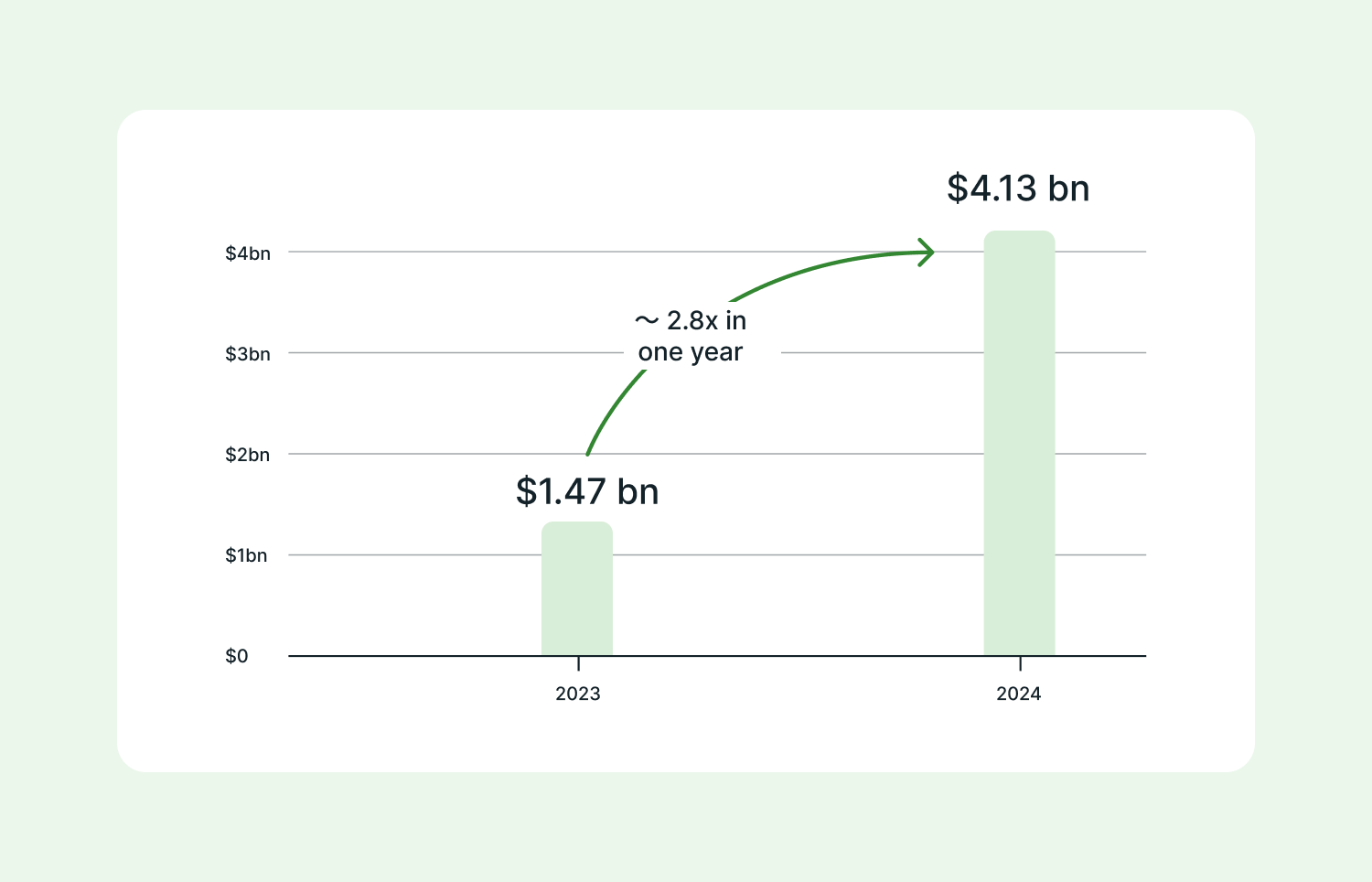
[Source: Thetius / Lloyd's Register, Beyond the Horizon (2024)]
Look closely at those announcements and a pattern emerges. These aren’t stories about buying tools. They’re stories about building: standing up software teams, data platforms and engineering cultures to make AI their own. And sooner or later, every one of them runs into the same wall.
The constraint is capability, not ambition
The gap between wanting AI and shipping it is now measurable, and it’s wide. When Thetius and Marcura surveyed more than 130 maritime professionals for their Beyond the Hype study, 81% were already running AI pilots, but only 11% had the policies and governance in place to scale them. The barrier respondents named most often (38%) wasn’t the technology. It was inadequate training.
Maritime’s AI ambition is running well ahead of its readiness
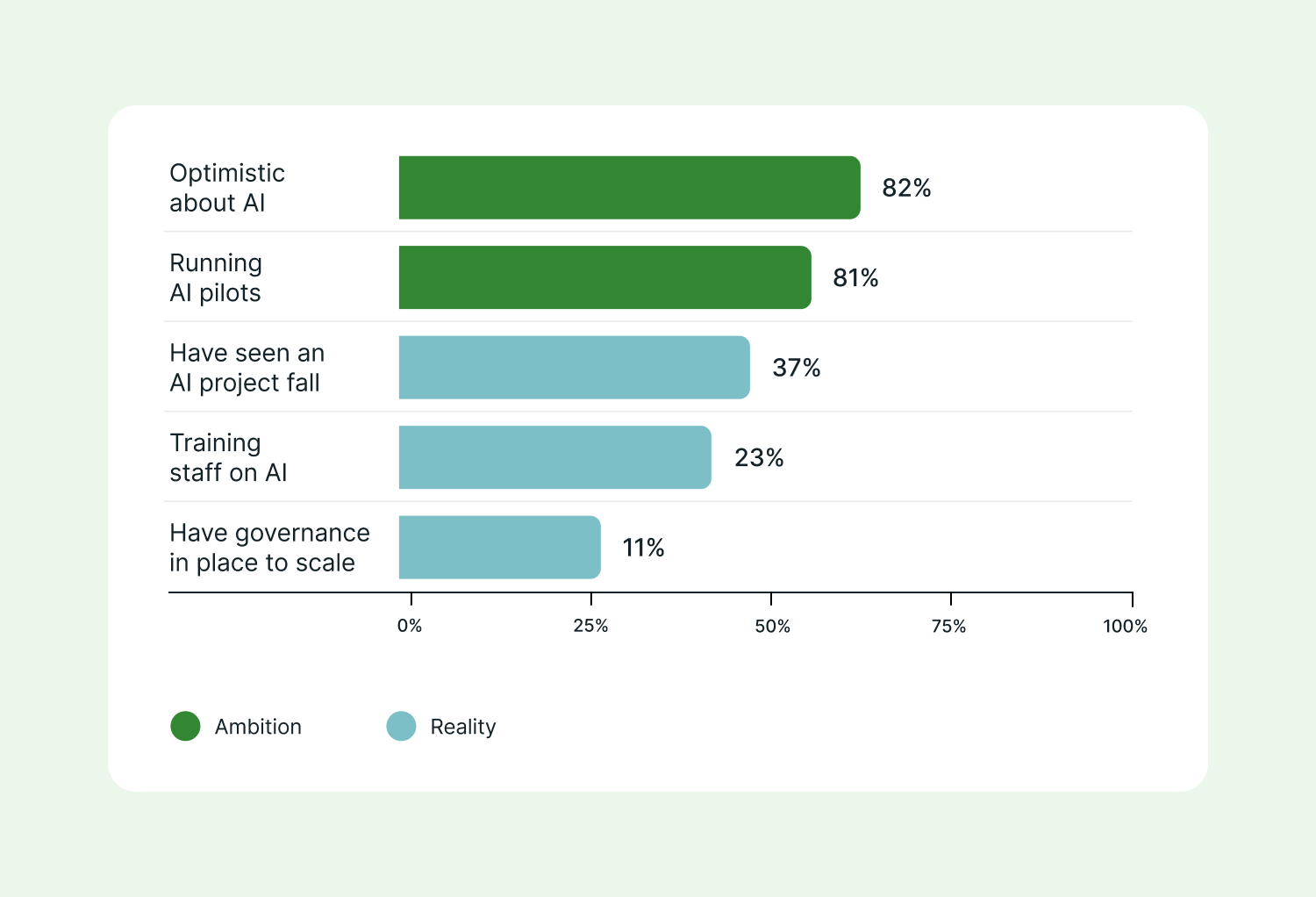
[Source: Thetius / Marcura, Beyond the Hype (2025)]
Maritime isn’t unusual here. MIT’s Project NANDA found that despite $30–40 billion of enterprise investment in generative AI, only about 5% of integrated pilots were extracting real value. The vast majority had no measurable impact on the P&L. The researchers were blunt about why, and it wasn’t infrastructure or regulation. It was learning: tools, teams and organizations that never adapted to how the work actually gets done.
What makes maritime’s version of the problem distinct is the pressure it’s under. In pharma, the hard constraint on AI is clinical validation. In banking, it’s model risk and explainability. In aviation, it’s safety-critical certification. In shipping, it’s a wave of regulation that turns out, at root, to be software work, and it’s all arriving at once. The EU Emissions Trading System now covers shipping, FuelEU Maritime is in force, the IMO’s Net-Zero Framework is working its way toward adoption, and IACS cyber-resilience requirements (E26 and E27) now apply to newbuild vessels. Each one lands on someone’s desk as an emissions data pipeline, a reporting integration, a chartering-system change or a class-data feed, built against a legal deadline on top of ERP and fleet-management systems that were never designed for it.
Everything, all at once: maritime’s compliance pile-up
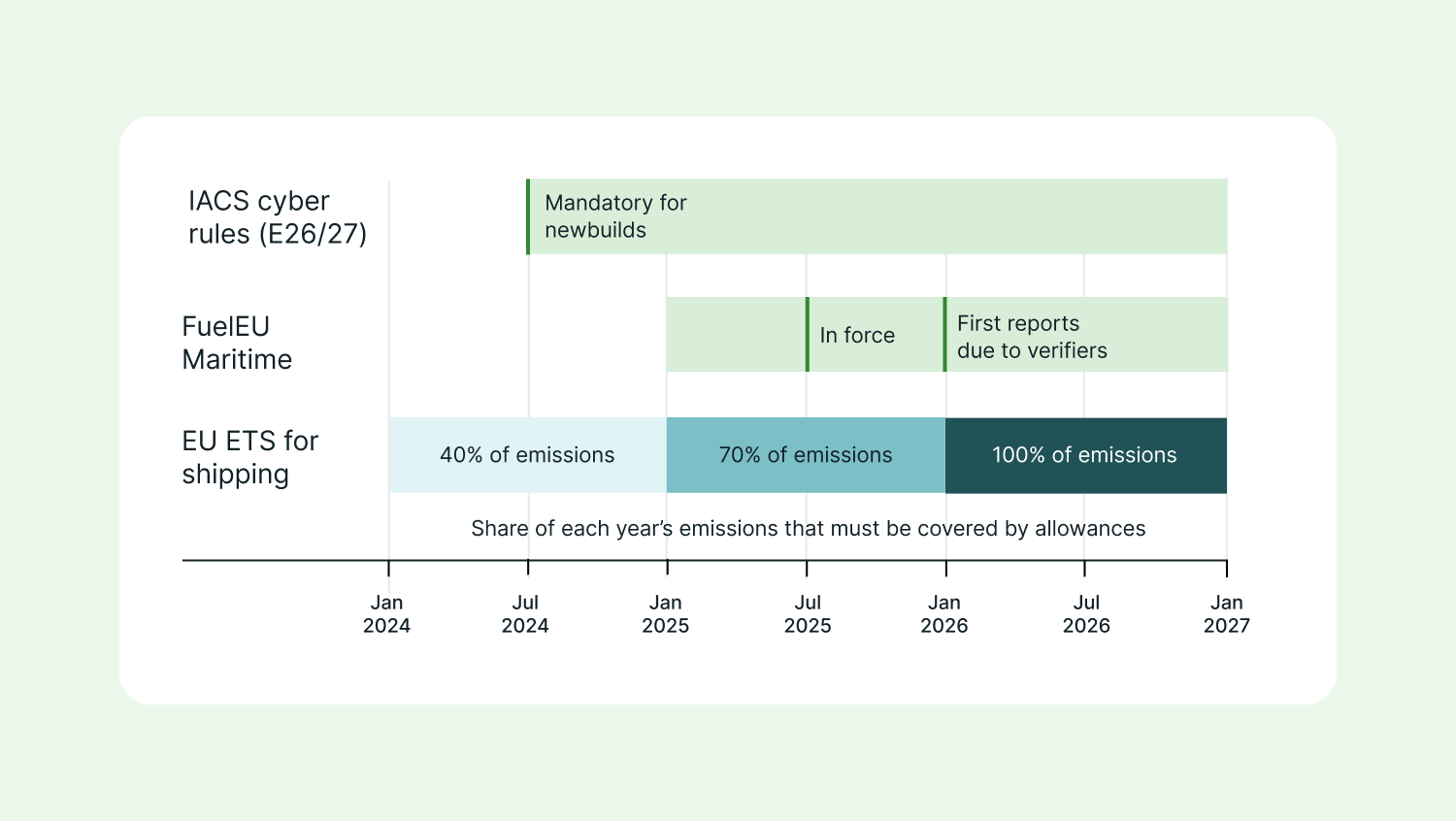
[Sources: IACS; European Commission (FuelEU Maritime, EU ETS maritime phase in)]
That’s why the real constraint sits with the shore-side engineering bench. The industry’s biggest players can buy models. What they can’t easily buy is the capacity to wire those models safely into decades-old systems while a regulator waits.
The scarce profile is narrower than “AI engineer”
The people who can do this work aren’t simply “AI engineers.” They combine AI fluency with maritime know-how. They understand why an emissions figure headed to a verifier needs more scrutiny than an internal dashboard, how a charter-party clause flows through a fleet-management system, and what a port EDI message actually contains. As Janani Yagnamurthy, VP Analytics at Marcura, put it, a general AI agent “might say that SF means standard form, but in shipping, it means stowage factor.”
That combination is rare, and the reason is an asymmetry worth sitting with. Domain knowledge takes years to build, and most of it lives in people’s heads rather than in any manual. AI fluency, by contrast, can be taught in months to someone who already has the domain. Wharton’s Sonny Tambe describes the people who will win as “bilingual — fluent in their field and fluent in AI.” For most maritime companies, the harder half of that equation is already on the payroll.
Which is why the open market is such a frustrating place to look, for three reasons that compound. The first is price. PwC’s 2025 Global AI Jobs Barometer, drawing on close to a billion job ads, found the wage premium for AI skills jumped to 56%, up from 25% a year earlier. AI skills are now the hardest to hire for anywhere. Maritime is bidding against big tech and fintech for that same shortlist. The second is churn. An expensive external hire with no domain grounding is both a flight risk and slow to become productive. The third, and most damaging, is what happens when a domain-fluent engineer leaves. The company pays market rate to replace them, but the salary was never the real cost. What walks out the door is years of hard-won context: how the fleet systems fit together, why a charter-party clause is handled the way it is, which reporting shortcuts a verifier will reject. None of it was written down, and none of it was ever priced in.
The price of AI skills more than doubled in a year
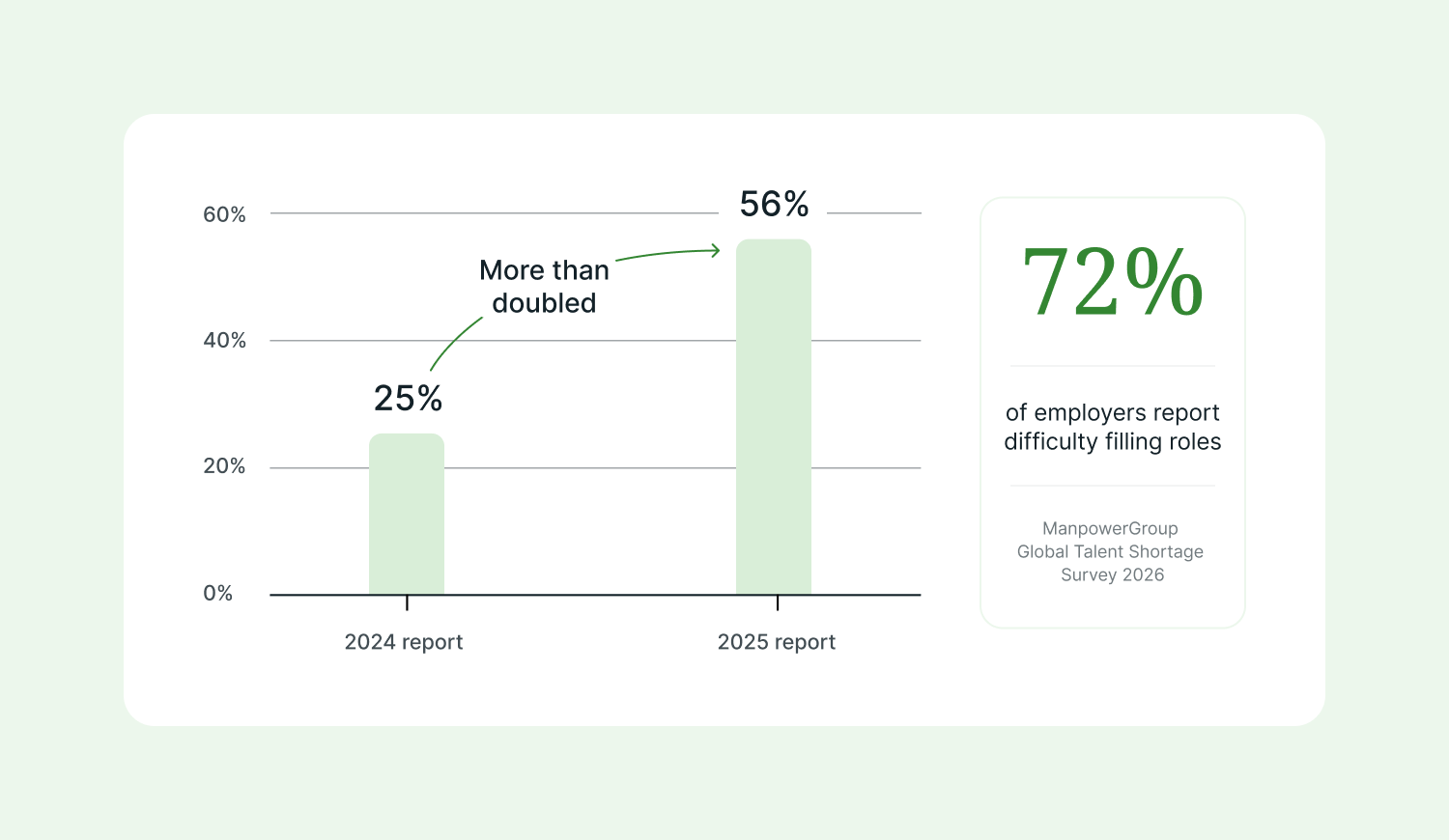
[Source: PwC Global AI Jobs Barometer (2024 and 2025 editions)]
The industry already has the scar tissue to prove it. TradeLens, the blockchain platform Maersk built with IBM, was shut down despite dozens of signed partners: sophisticated technology that never quite met a real workflow or earned the industry’s trust. MIT’s research points to the same lesson from another angle. AI projects built with specialist partners were roughly twice as likely to reach deployment as those built entirely in-house.
Maersk’s response is instructive because it treats this as a build problem, not a buy problem. Under CTIO Navneet Kapoor, the company deliberately built an internal technology organization, hiring thousands of engineers while recruiting from big tech and startups. It grew to more than 5,500 tech employees and cut external IT staff from around 70% of the total to 30%. Its Bengaluru technology center alone now holds roughly 2,500 people across software, data science, AI and cybersecurity, and has secured more than ten AI patents. That’s what making AI your own actually costs: years of organizational rebuilding, a deliberate shift from outsourcing to insourcing, and a running battle to keep domain-fluent people once they’re trained.
Most maritime companies can't take Maersk's route, and most don't try. Shore-side dev teams tend to be small, and the industry's habit has long been to outsource the build and hope the knowledge follows. It rarely does. There is a middle path: a managed solutions model, where a partner team delivers the platform or integration inside the company's own systems while deliberately building up the internal engineers working alongside it. The distinction matters. TradeLens didn't fail because a partner was involved; it failed because the technology never met a real workflow. A managed engagement done well starts from the workflow and ends with a stronger internal team, which helps explain why MIT found partnerships twice as likely to reach deployment.
Why “buy more generalists” is the wrong instinct
There’s a deeper reason that hiring more generalist engineers isn’t the answer, and it has to do with how software itself is now built. AI has raised every engineer’s raw output. DX’s Q4 2025 impact report, drawing on more than 135,000 developers across 435 companies, puts adoption of AI coding assistants at around 91%, with roughly 22% of merged code now AI-authored.
But the productivity story is more sober than the headlines. DX found most organizations saw pull-request throughput rise 10–15%, not the tenfold gains often promised, partly because, according to Microsoft research, only about 14% of a developer’s time goes to writing code in the first place.
AI is everywhere in engineering. The gains are not.
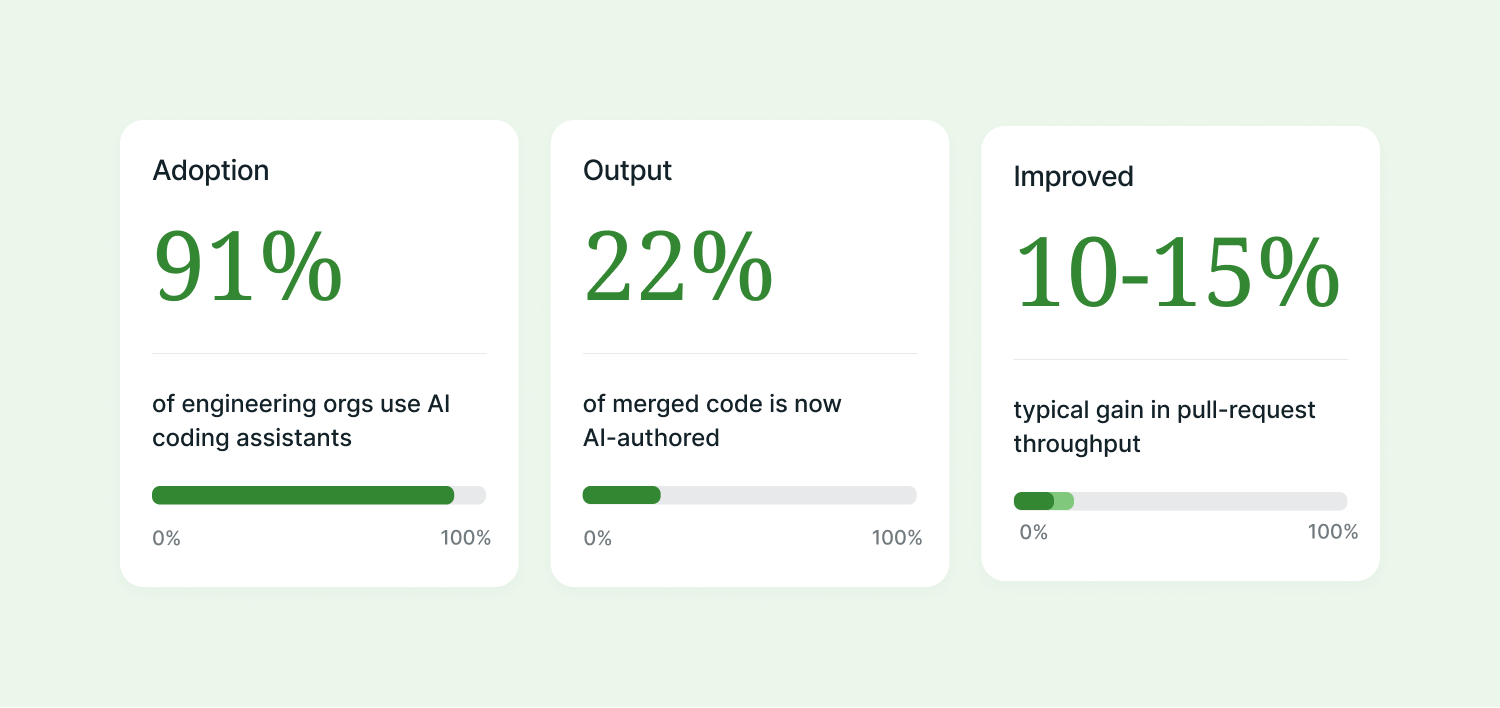
[Source: DX, AI-assisted engineering; Q4 2025 impact report]
The lesson is structural. When AI speeds up the fast, teachable half of the job (writing code), the bottleneck shifts to the slow half: judgment, domain modeling, code review, orchestrating AI agents and working with stakeholders. The craft of writing code by hand matters less. Knowing what to build, and whether the machine’s answer is right for a maritime edge case, matters more. As DX puts it, AI “accelerates whatever culture you already have.” So the highest-leverage move isn’t hiring more generalists whose main advantage, raw coding speed, AI has just reduced the premium on. It’s making the domain-fluent engineers you already have AI-native.
What effective upskilling looks like
This is where most training strategies stumble. Some default to a webinar series, a one-off course or a stack of self-serve licenses and hope it sticks. Others swing the opposite way and pull engineers out of the business for weeks of classroom time nobody can spare. Neither changes how people work. Passive, one-time sessions fade quickly, and leadership-development research has long suggested that less than 10% of the learning needed for advanced roles happens in a classroom at all.
What works is a hybrid model that blends the formats rather than choosing between them. Self-paced learning builds a shared foundation on each engineer’s own schedule. Live, expert-led cohort sessions turn that foundation into judgment, with room to ask questions, debate trade-offs and learn from peers. And the learning is anchored in real work: a capstone built on the team’s own systems, whether that’s an emissions reporting pipeline, a chartering-system integration or an agentic DevOps workflow, with experienced engineers reviewing and coaching along the way. Practice is spaced over weeks rather than crammed into a few days, so it has time to become habit.
The programs that scale best also build their own multipliers. Training a group of internal champions to coach their peers keeps the capability spreading after the formal program ends. And success is measured by what ships to production, not by who completed the course.
A hybrid model for AI upskilling
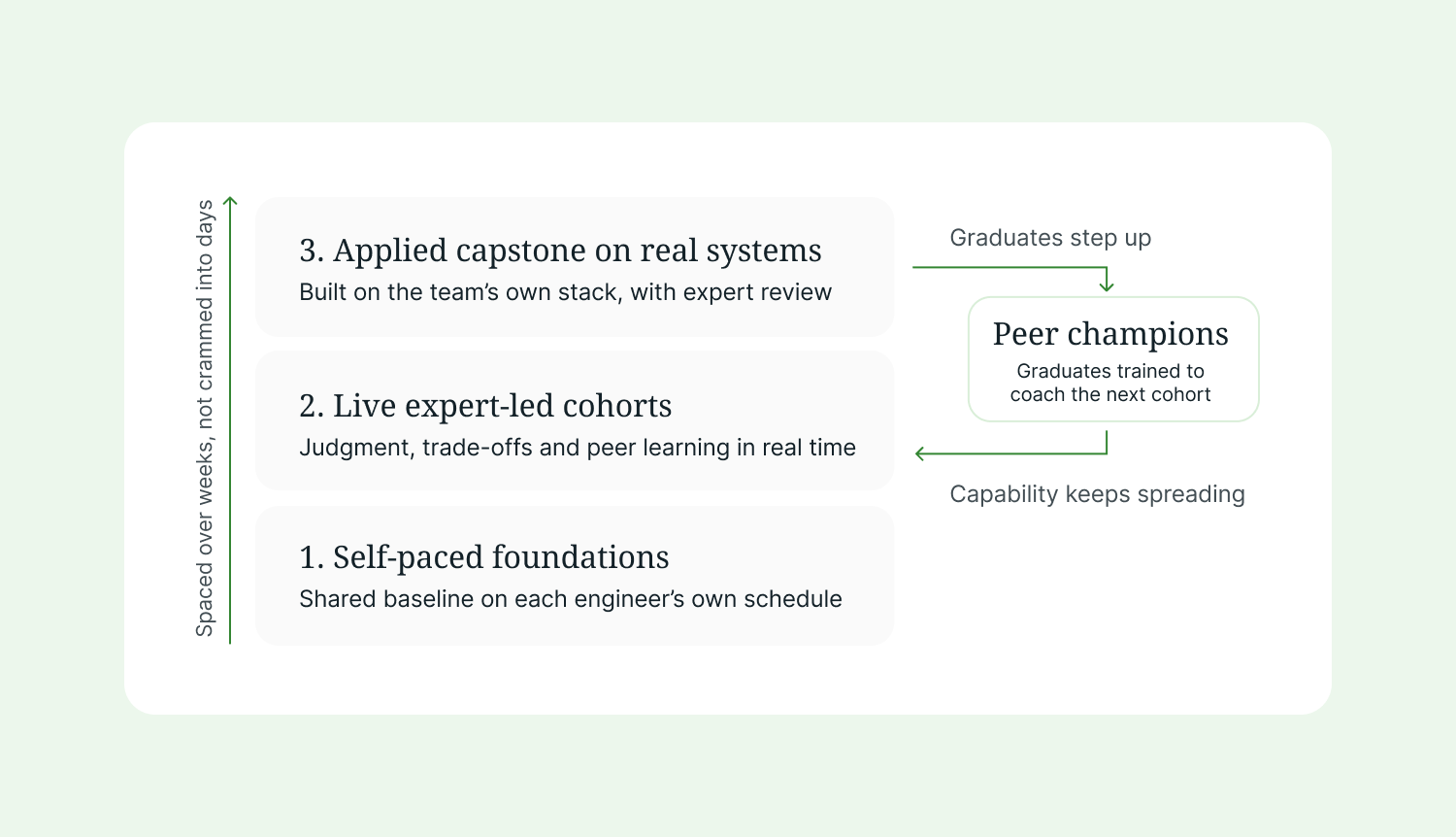
Measured by what ships to production, not by course completion
Every serious study of the pilot-to-production gap lands in the same place. Thetius and Marcura named training as maritime’s top barrier. MIT called it a learning gap. DX found that outcomes depend on engineering practice, not tool adoption. And the maritime AI failures documented in Beyond the Hype were “not technology problems” but ones “rooted in people and processes.” If the problem is people, the fix has to be too.
The strategic reframe
So the question for anyone responsible for engineering capability in maritime is not “how many AI engineers can we hire?” It is “who is going to build this, and how much of the answer is already inside the building?”
The organizations that pull ahead over the next two years will run four motions at once, not one after another:
- Upskill and reskill existing engineers to become AI-native without losing the domain knowledge they already hold, through a hybrid program that blends self-paced foundations, live expert-led cohorts and real builds on their own systems.
- Bring in specialist engineers who already have domain knowledge where a live platform build or a regulatory deadline cannot wait.
- Source specialist engineers from a wider global talent pool who may not yet have the domain context, and let them absorb it alongside the upskilled internal team, so hiring and training work as a single loop.
- Partner for managed delivery where the internal team is too small to absorb the work, with knowledge transfer built into the engagement so the capability stays when the partner steps back.
Where Andela fits
Andela works across every one of these motions for enterprise engineering teams. We place pre-vetted specialist engineers from a global talent network where a platform build or regulatory deadline can't wait. We deliver managed solutions for teams too small to take the work on alone, building inside their systems and handing capability back as we go. And we run hybrid upskilling programs that turn existing engineers into AI-native ones. All of it runs in parallel rather than in sequence.
The model is proven at scale. With GitHub, Andela trained 200 internal facilitators who went on to train 3,000 developers on GitHub Copilot, with a 92% facilitator pass rate and an 80% increase in tool adoption. For AstraZeneca, Andela closed a fifty-engineer gap in eight weeks.
Maritime has the money and the mandate. What it needs now is an honest map of where its engineering bench actually sits against the roadmap it has been asked to deliver, and the discipline to build the people, not just buy the tools.
Sources
- CMA CGM Group, “CMA CGM and Mistral AI partner to deploy artificial intelligence,” April 2025
- Deloitte Denmark, “Digital transformation reshapes Maersk from shipping giant to global logistics integrator,” 2025
- Hapag-Lloyd, Strategy 2030
- DSV A/S, “Leverage to Lead” Capital Markets Day, May 2026
- Lloyd's Register and Thetius, “Beyond the Horizon: Opportunities and Obstacles in the Maritime AI Boom,” 2024
- Thetius and Marcura, “Beyond the Hype: What the Maritime Industry Really Thinks About AI,” September 2025
- Marcura, “Why Maritime AI projects fail and how to be successful,” 2025
- IACS, Unified Requirements E26 and E27 on cyber resilience of ships, 2023–2024
- European Commission, “Decarbonising maritime transport – FuelEU Maritime”
- European Commission, EU ETS for maritime transport
- MIT Project NANDA, “The GenAI Divide: State of AI in Business 2025,” July 2025
- A.P. Moller–Maersk, “A.P. Moller–Maersk and IBM to discontinue TradeLens,” November 2022
- Navneet Kapoor, Maersk, “The amazing challenge of digital transformations,” January 2023
- YourStory, “Maersk aims to strengthen technology depth in India GCC,” September 2025
- PwC, 2025 Global AI Jobs Barometer
- ManpowerGroup, 2026 Global Talent Shortage Survey
- Sonny Tambe, Wharton, “Reskilling the Workforce for AI,” October 2025
- DX, “AI-assisted engineering: Q4 impact report,” November 2025
- DX, “8 myths on software engineering and AI”
- Andela, GitHub Copilot training case study
- Andela, AstraZeneca case study
Figures are drawn from the sources listed above and reflect the most recent data available at the time of writing (October 2026).
Recent articles



.webp)
.webp)
.webp)
Insights for leaders building AI systems
Weekly digest of the most important ideas in AI transformation.