
Africa's emergence as the world's next IT services and AI talent destination


A comparative analysis of India's service-led rise and the three accelerators positioning Africa as the next global sourcing market.
Key Findings
- Africa's developer population has reached 4.7 million and is growing faster than any other continent's. Nigeria's 45% year-over-year developer growth in 2023 was the largest increase worldwide, and GitHub projects Egypt, Nigeria, Kenya, and Morocco will each add millions of developers by 2030 [1][2][3].
- Africa is the only major region with a growing working-age population and a falling dependency ratio. By 2050 it will hold one-third of the world's youth and the largest working-age workforce on the planet [4][5].
- Capital is arriving at a scale India never saw at a comparable stage: a $1 billion Microsoft and G42 Azure region in Kenya, Google exceeding its $1 billion continental commitment, roughly $118 billion in UAE investment from 2020 to 2024, a $103 billion Qatari pledge, and $25 billion committed by Saudi Arabia through 2030 [6][7][8][9].
- The structural conditions mirror India circa 1991: a young, English-proficient, low-cost talent base meeting surging global demand. The difference is speed through digital leapfrogging (e-learning over campuses, satellite over fiber, mobile money over branch banking) lets Africa compress India's 30-year climb [10][11].
- Senior engineers in Lagos and Nairobi earn $20,000 to $48,000 per year against $150,000+ for comparable U.S. roles, with substantial overlap in U.S. and European working hours [12][13].
Abstract
The challenge facing Africa is that risk is priced in but upside isn’t. In an attempt to map the long term upside, we can compare Africa’s future growth with that of India’s from agrarian economy to global IT services provider. We look at this comparison because it’s one of the cleanest examples of service-led development in the modern economy. It also shows that a developing nation can build high-value growth on digital services and human capital.
Today, Africa is at a comparable inflection point to India in the early 1990s. However, it is arriving with three tools India never had: digital leapfrogging; the world’s youngest and fastest-growing workforce; and large amounts of capital investment on the heels of AI. For enterprise leaders, the question is no longer whether Africa follows a tech-led path, but where and how fast it will scale to impact business operations.
India Then, Africa Now
India entered 1991 in a balance-of-payments crisis with reserves covering two weeks of imports. The liberalization that followed, combined with English-speaking engineering talent and Y2K-era global demand, turned a 3.5% growth economy into the world's IT outsourcing leader. Today, services now contribute 60% of gross value added and 48% of exports [14][15]. The relevant question is whether the same preconditions are now assembling in 2026 Africa. Empirically, they are on par with 1991 India. And in a few specific cases, the African starting position is stronger.
Accelerator 1: Digital Leapfrogging
India built its IT sector the slow way: physical campuses, terrestrial fiber, brick-and-mortar banking. Africa is skipping those stages outright. The continent famously went from fewer landlines than Manhattan to global leadership in mobile money; M-Pesa formalized finance for millions without a single new branch [10][11]. The same pattern now applies to talent development (e-learning and cohort-based training instead of decade-long campus construction) and connectivity (Starlink and 45,000 km-plus subsea systems like 2Africa instead of waiting on fiber) [18]. Leapfrogging matters commercially because it compresses time-to-supply: India spent a decade building each, while Africa can adopt in a single procurement cycle.
Accelerator 2: Working-Age Population Growth
The number one most fascinating asset Africa has is its population growth. Africa's median age is 19.4 years against India's 28.4 and Europe's 42.5. Sub-Saharan Africa's working-age population will double between 2020 and 2050, making it the only major region in the world where the workforce is growing while dependency ratios fall [4][5]. By 2050, one in four people on Earth will live in Sub-Saharan Africa.
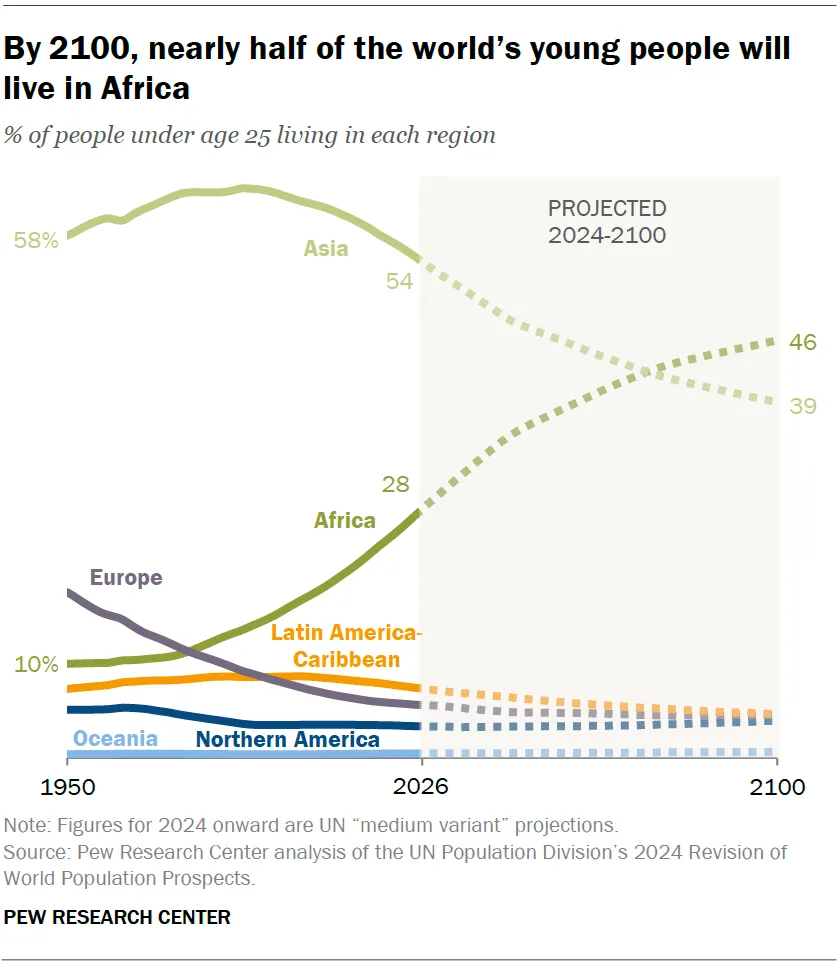
It’s important to note that in order to support this growing population, Africa must generate roughly 2 million jobs per month, which is why export-oriented IT services demand is being welcomed by policymakers [25]. Following Tunisia (2018) and Senegal (2019), a wave of national “Startup Acts” (Nigeria’s 2022 law is the most comprehensive) now offer tax incentives, startup labeling, and lighter regulation. In addition to opening the door to local innovation, regulatory advances signal to global investors that African innovation sits on increasingly stable legal footing [26].
Accelerator 3: The Influx of Capital
India's rise was largely self-financed. Africa's is being pre-funded with Gulf sovereign capital and U.S. hyperscalers committing at levels that did not exist for any prior emerging sourcing market. Venture funding reached $3.9 billion in 2025 with debt financing at a record $1.8 billion and M&A up 34% year over year; signs of a maturing rather than speculative market [17][20].
The single largest structural reform underway is the African Continental Free Trade Area (“AfCFTA”), which knits 54 economies, 1.4 billion people, and a combined GDP of roughly $3.4 trillion into one market [16][27]. For enterprises, the AfCFTA is the mechanism that turns 54 fragmented national markets into the scale needed for serious, vertically integrated regional operations. It’s the same unification logic India pursued domestically with its Goods and Services Tax.
The Talent Case: Can Africa Actually Staff the Demand?
India won not because it was cheap but because it paired technical talent with English proficiency at scale; plenty of low-cost countries never converted for lack of that pairing. So the real test for Africa is the talent pipeline. Fortunately, Africa’s roughly 4.7 million software developers are growing about 21% a year, the fastest rate of any region. For an enterprise or hyperscaler projecting its talent supply over a 10-to-20-year horizon, Africa is where they will be.
Beyond the 4.7 million existing developers, the training model is leapfrogged too: Kenya has made programming mandatory in primary and secondary school; India is exporting its own playbook through IT campuses in Zanzibar and Nigeria; GitHub and Microsoft launched GenAI for Youth across South Africa, Nigeria, and Kenya; and pan-African e-learning cohorts now scale AI skills without waiting for new universities [2][22][23]. Most African developers specializing in AI, machine learning, and data science today are concentrated in North Africa and Kenya, giving buyers a clear map of where advanced skills already cluster [19].
Realizing a global future that’s distinctly African
The three accelerators (digital leapfrogging; the world's fastest-growing working-age population; and an unprecedented influx of capital) are compounding now in Africa. Africa is undoubtedly poised to become a primary global talent market. Implications: enterprises will have three years of delivery experience there when it does, and which will be starting from zero. f you’re a C-level executive, it’s strategic to look 3 years out at your talent strategy
If you’re looking for a starting point, I suggest looking at it like this:
- Name Africa explicitly in strategic workforce plans rather than bundling it into the "rest of world."
- Enter through vendor-led delivery pods in established hubs (Lagos, Nairobi, Cairo, Cape Town, Accra) before committing to captive centers, mirroring how Fortune 500 firms first entered India.
- Evaluate providers on export-oriented metrics: verified developer counts, AI-skill assessment data, English proficiency, and enterprise delivery track record, not headcount alone.
- Move while the arbitrage holds. Enterprises that built India strategies before 2000 captured a decade of pricing and talent advantage over those that waited for consensus.
By 2030, Africa will have the talent, infrastructure, and global connectivity it took India decades to build. Act accordingly.

.png)