
GitHub x Andela x TechTalk in London: Engineering and bottlenecks go way back. AI moves the goal posts.

What does “good engineering” look like when AI is able to plan, write, and ship code?
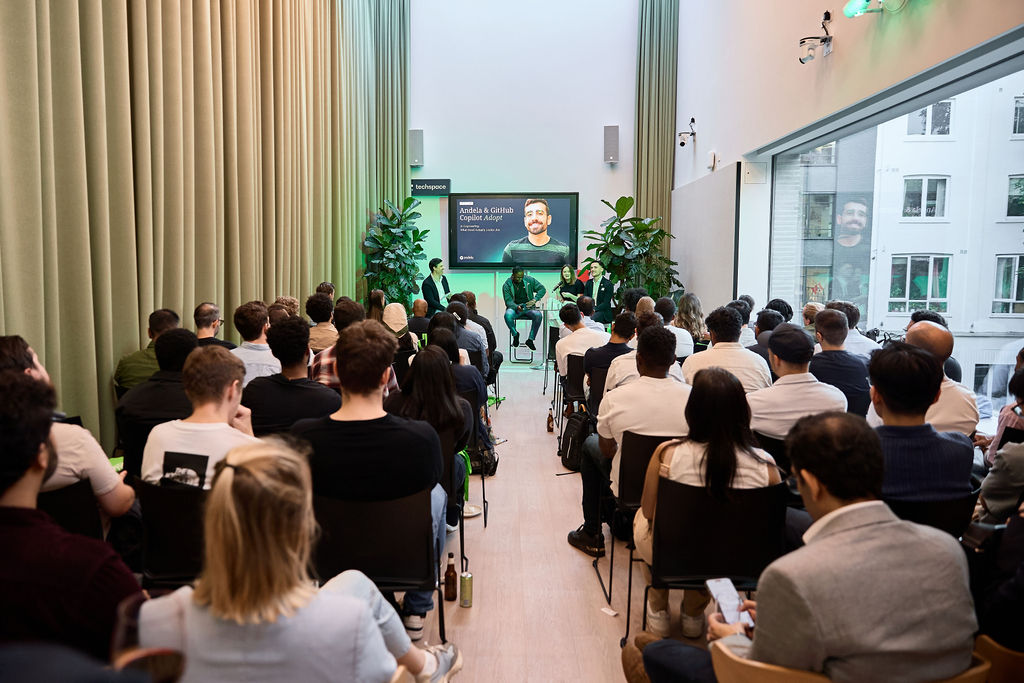
That’s the central question raised during presentations by Andela and GitHub at a TechTalk builder event in London. Following talks from Andela’s Nicola Lyons, Senior Director of Talent Operations, and GitHub’s Jack Rawlings, Senior Partner Development Manager, a practitioner panel discussed key opportunities and bottlenecks emerging as AI takes on more coding.
During the program, attending engineers and technology leaders were able to discuss what happens when AI moves from autocomplete to agents that can plan, write, and submit code.
While the conversation was wide-ranging, it became clear that AI is introducing new challenges and the coding bottlenecks have moved, rather than disappeared. A key takeaway: Most teams are still figuring out how to measure the impact of new bottlenecks created by AI, develop processes that limit or eliminate them, and build teams around AI in the most strategic way.
A snapshot of the panel and thoughtful audience participation through the lens of bottlenecks:
Bottleneck #1: Writing code
For decades, software innovation moved at the literal speed of people writing code. With AI-powered coding tools, it’s possible (and plausible) to produce 10x or 15x more code in the same time frame as it used to take an engineer to produce a single entry of product-ready code.
During the event, GitHub data was shared to highlight substantial differences in pull-request throughput between developers opting to abstain from using Copilot, code completion, and agentic workflows. According to the data, single-agent adoption was associated with roughly four times the PR volume. Meanwhile, multi-agent workflows reached roughly 10 to 15 times the throughput of non-Copilot users.
On its face, this data reflects potential productivity gains in the 10-15x range. But, in reality, it massively scales the amount of code moving from writing to review cycles. This places stress back on the organization that adopted AI coding tools to speed up output and absorb the swelling review backlog.
Bottleneck #2: Code Review
AI can write and ship code, but review still requires a human in the loop to confirm a lack of hallucinations and ensure code accuracy.
Every time a process returns from AI to humans, a bottleneck emerges with time as the culprit.
A direct question from an audience member places this into context: What happens when an engineer is dealing with pull requests involving 55 changed files and 15 reviews a day?
The answer: Engineers must establish an important AI boundary – the agent can assist with review; it should never be responsible for approving its own work.
AI can dramatically increase production speed, but human judgment is crucial for quality assurance. While relying on people to review doesn’t scale at the same levels as AI tooling adoption, it’s the best option right now.
Bottleneck #3: Context
During the event, a common issue kept getting raised: AI agents are boosting productivity, but they’re missing solutions already in the system.
An overloaded agent can struggle to identify what matters. This presents a new bottleneck with a similar demand. It requires engineering teams to re-introduce an analog step in the process: human double-checking.
Another change discussed during the event: breaking a broad task into specialized agents and incorporating corrections from previous mistakes into their instructions.
A context breakdown is also demanding a shift in how engineers prompt AI for coding projects. Prompting is moving from posing a question to providing the underlying context for AI agents to help them connect dots that currently remain fragmented.
As it stands now, AI agents need better context, more narrow tasks, and accurate information to deliver near-perfect outputs. Ensuring these conditions are met falls squarely on engineers prior to AI agents running more targeted prompts.
Bottleneck #4: Requirements
As AI takes on coding, the challenge moves from managing an individual engineer’s workload to ensuring the accuracy of agents pumping out 10-15x more code per session than human counterparts.
That emerging reality places requirements, product specifications, UX decisions, user stories, and business context under a new spotlight.
In other words, the next productivity breakthrough may come from helping organizations decide what to build faster, rather than helping team members produce code more efficiently. Requirements are at the center of this shift.
Bottleneck #5: Skills
A clear and present challenge for everyone in attendance: how to skill up and staff up around AI.
During the event, panelists argued for doubling down on fundamentals: problem solving, system design, critical thinking, and communication. A key point raised: AI forces teams to audit and redistribute skills, rather than replace them.
AI adoption makes individual skills more valuable because they determine whether an engineer can effectively prompt, direct, and evaluate AI-generated outputs.
The panel also pushed back on the idea that engineers should become generalists simply because AI makes it easier to work across stacks. Specializations and skills will continue to differentiate engineers on an individual level and help organizations make strategic staffing decisions as they adopt or integrate more AI tooling.
The engineering discipline is fundamentally shifting as AI takes on writing and shipping code. Engineering leaders and business executives like CIOs or CTOs hold the accountability at the moment to deeply understand the real skills of their organizations. Presenters from Andela shared how they are working with leaders to assess and upskill teams so they avoid creating talent debt alongside technical debt. This is a complex environment to navigate and executives are turning to partners to support them.
Bottleneck #6: Cost
The economics of software development are also fundamentally changing as AI agents take on more tasks and accountability. It requires engineering leaders to consider AI usage alongside traditional measures such as engineering time and headcount.
During the program, panelists discussed GitHub's multi-model approach that allows teams to match models to tasks: lighter models for simpler work and more capable models for deeper planning or complex problems. One example discussed at the event involved a modernization project originally scoped to take nearly a year that was reframed around token costs and ultimately delivered in weeks.
The question increasingly facing engineering leaders with financial accountability, "What is the right combination of people, agents, models, and tokens to get this done?"
Engineering remains a game of bottleneck management
The event served as further confirmation that the shelf-life of a technical skill is shrinking; from roughly a decade in the past to around two years today. As AI improves and takes on more coding responsibilities, it’s possible that soon skills will only remain relevant for months, rather than years.
Bringing Andela, GitHub, and TechTalk communities together created a vibrant space for practitioners, engineers, and people building with AI today. Attendees were able to compare notes on what is actually working, where organizations are struggling, and how the definition of engineering excellence is changing. Panelists were able to draw on GitHub data and real-world context from Andela’s client work to support organizations trying to rethink talent and tooling in the AI era.
The key to success for engineers: get better at learning, prioritizing, and adapting. Don’t over-index on one skill or discipline. Go into perma-adapt mode and continue learning throughout the remainder of your career. Or risk obsoletion.
Ready to turn AI capability into measurable impact? Learn more.
.png)