Enable agent-first engineering teams that ship faster with AI
The gap between agentic investment & adoption is enablement
Enterprises realize value from agents only when engineers build the judgment, confidence, and shared practices to use them in real work.
Three levels of applied agentic enablement
Advance from foundational agent skills to complex orchestration and production AI solutions.
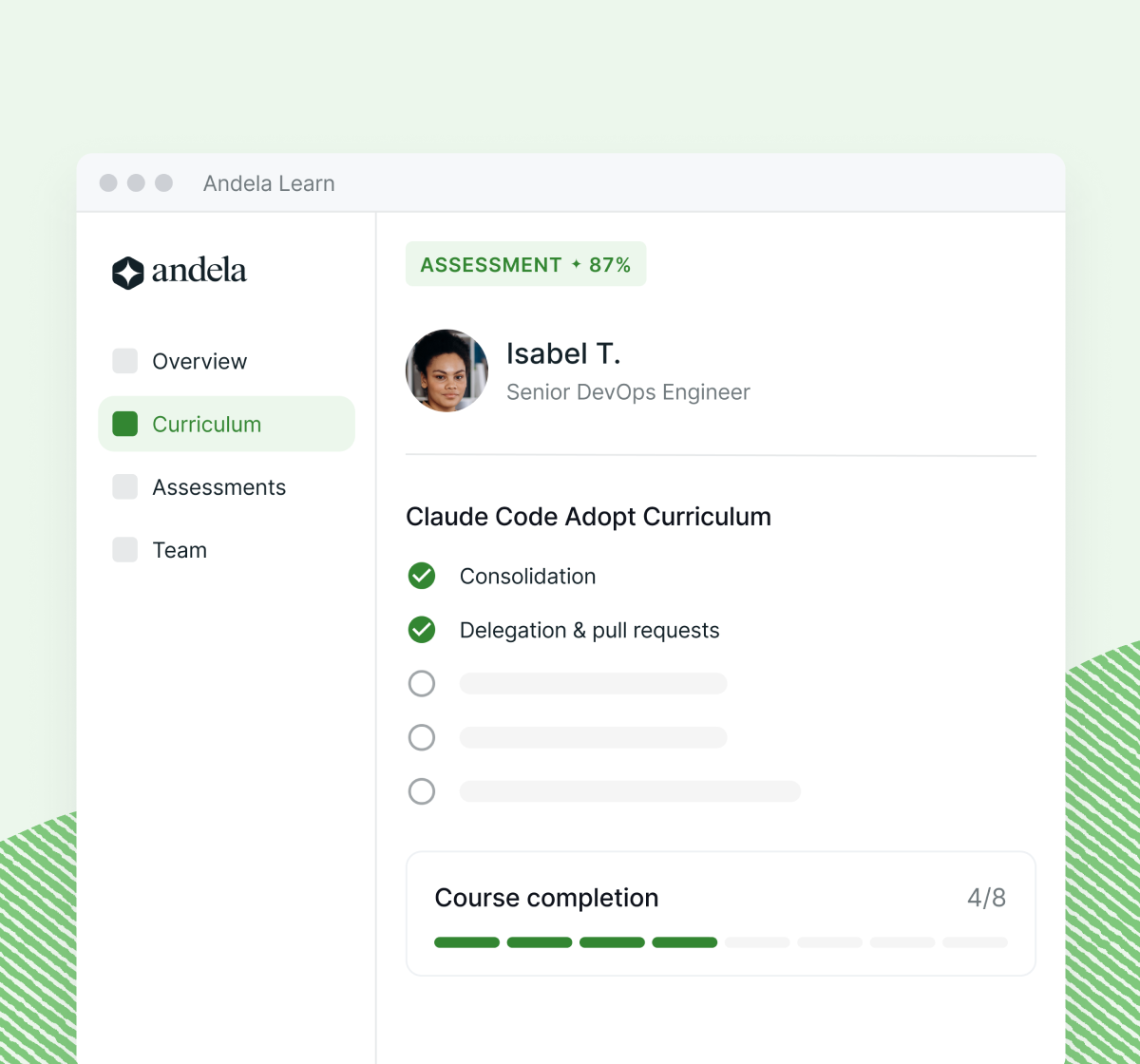
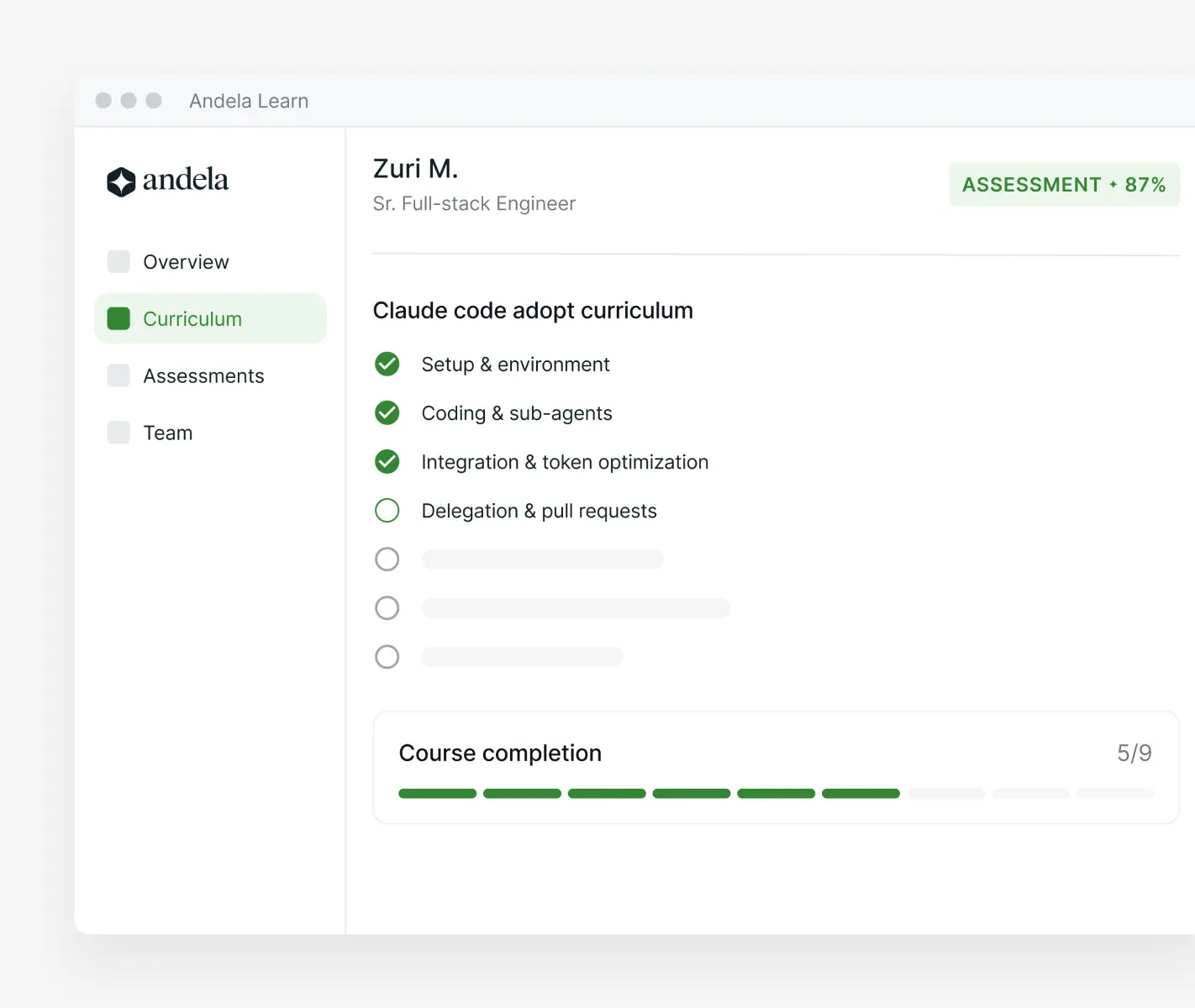
Build consistent agentic use and the judgment to direct, verify, debug, refactor, test, and build simple agents.
- Automate repetitive tasks
- Accelerate individual workflows
- Build practical agent fluency
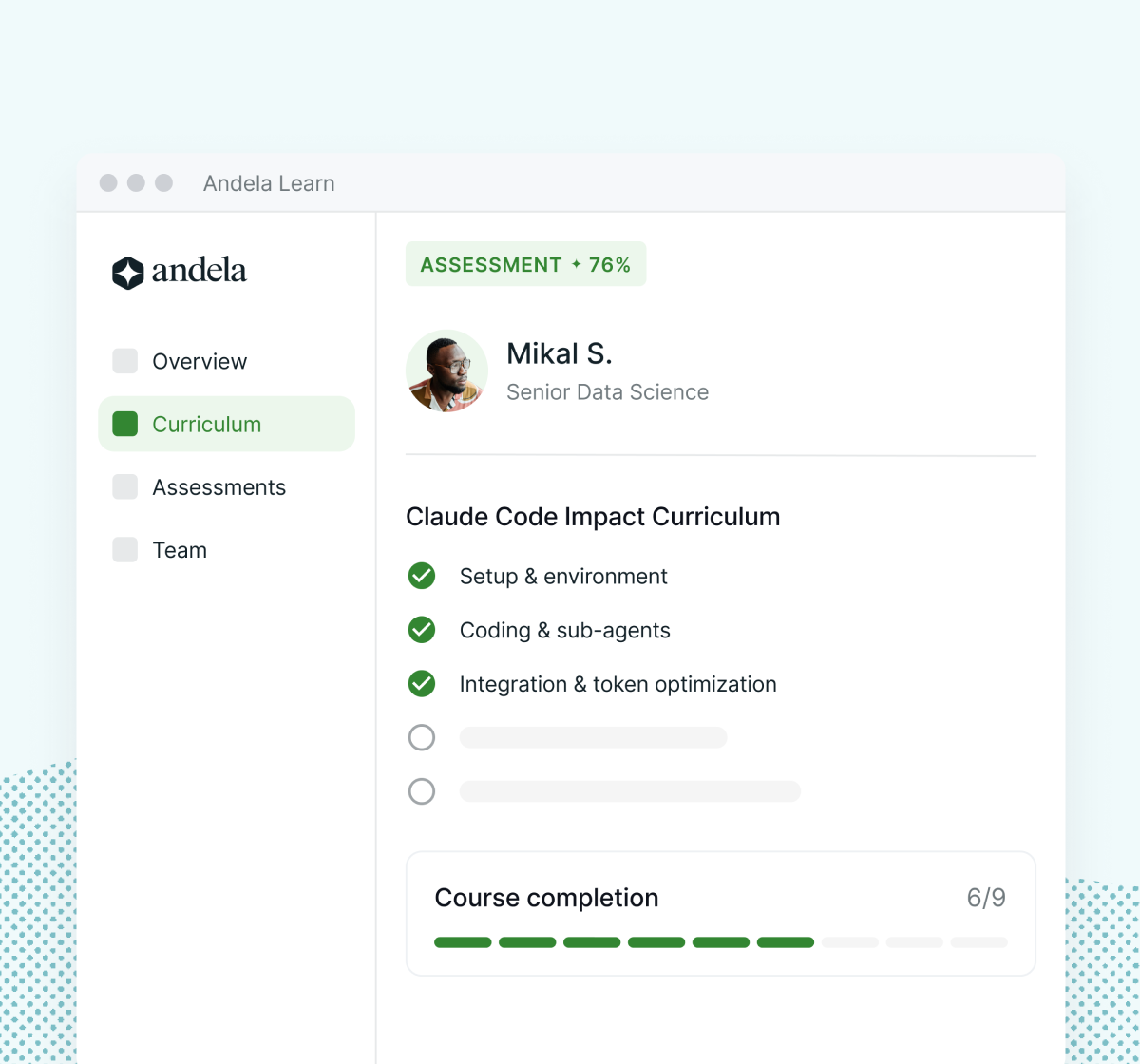
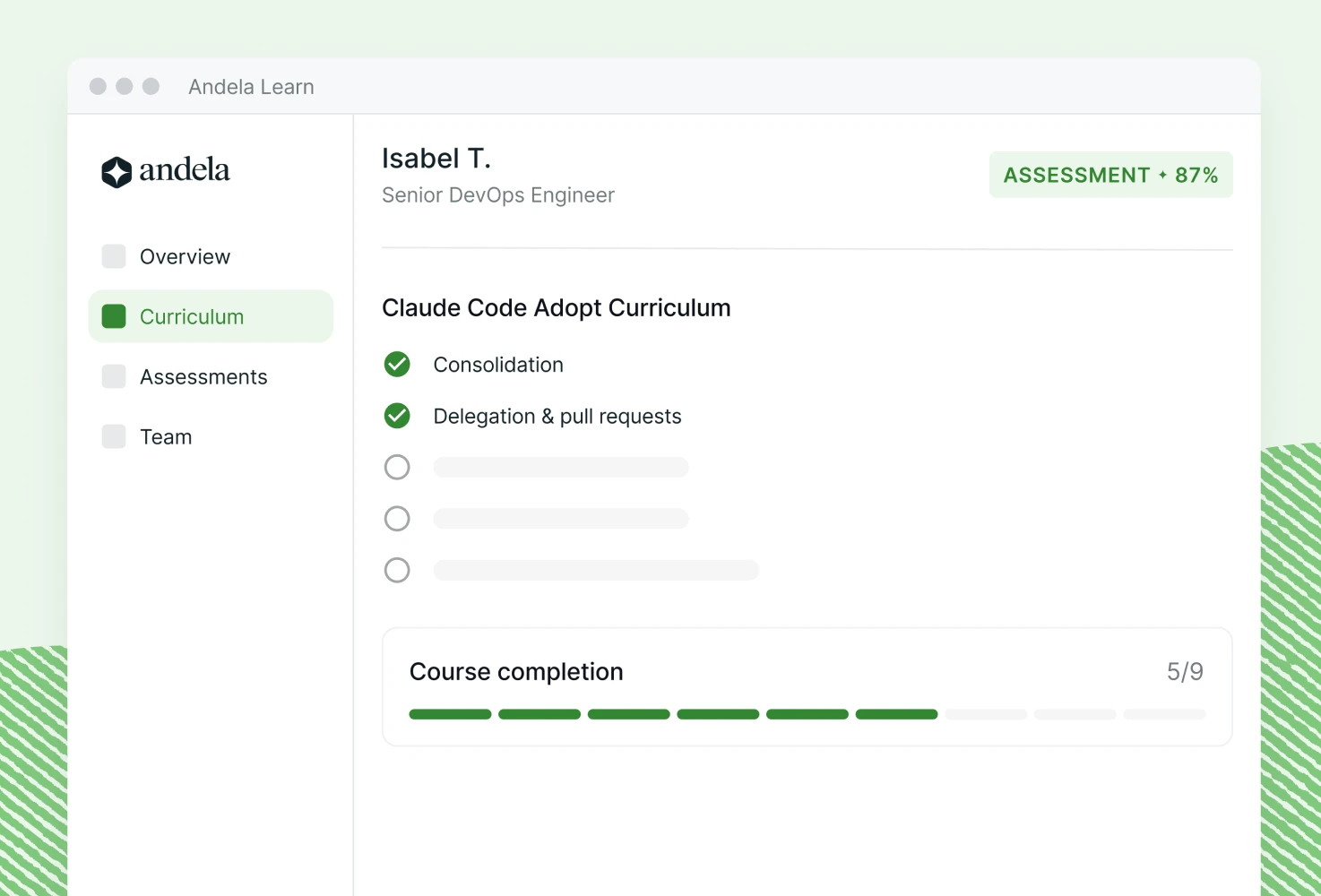
Apply advanced agentic engineering capabilities, including orchestration and multi-agent patterns, to more complex individual workflows.
- Connect agents across workflows
- Coordinate multi-step work
- Scale human + agent collaboration
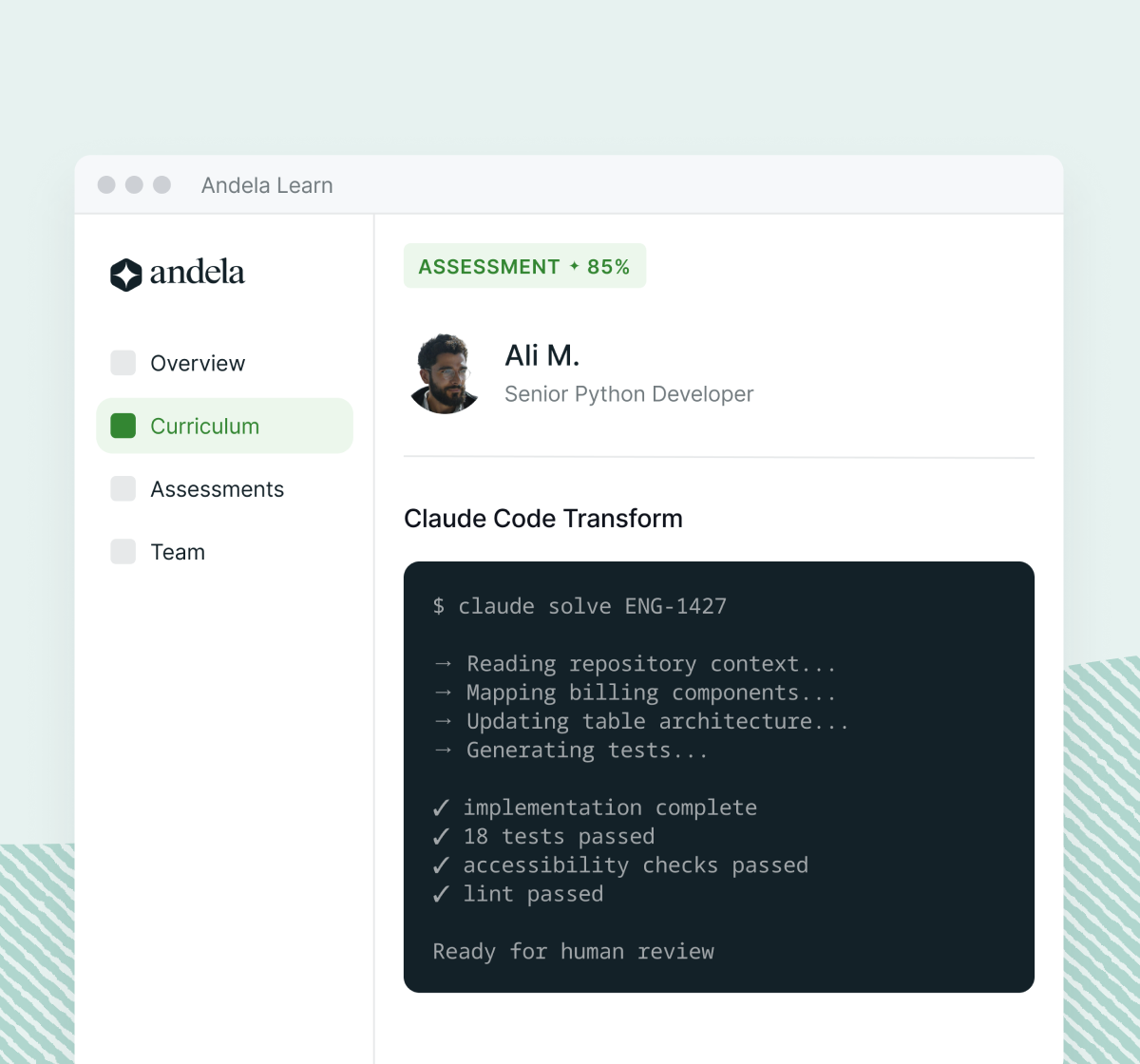
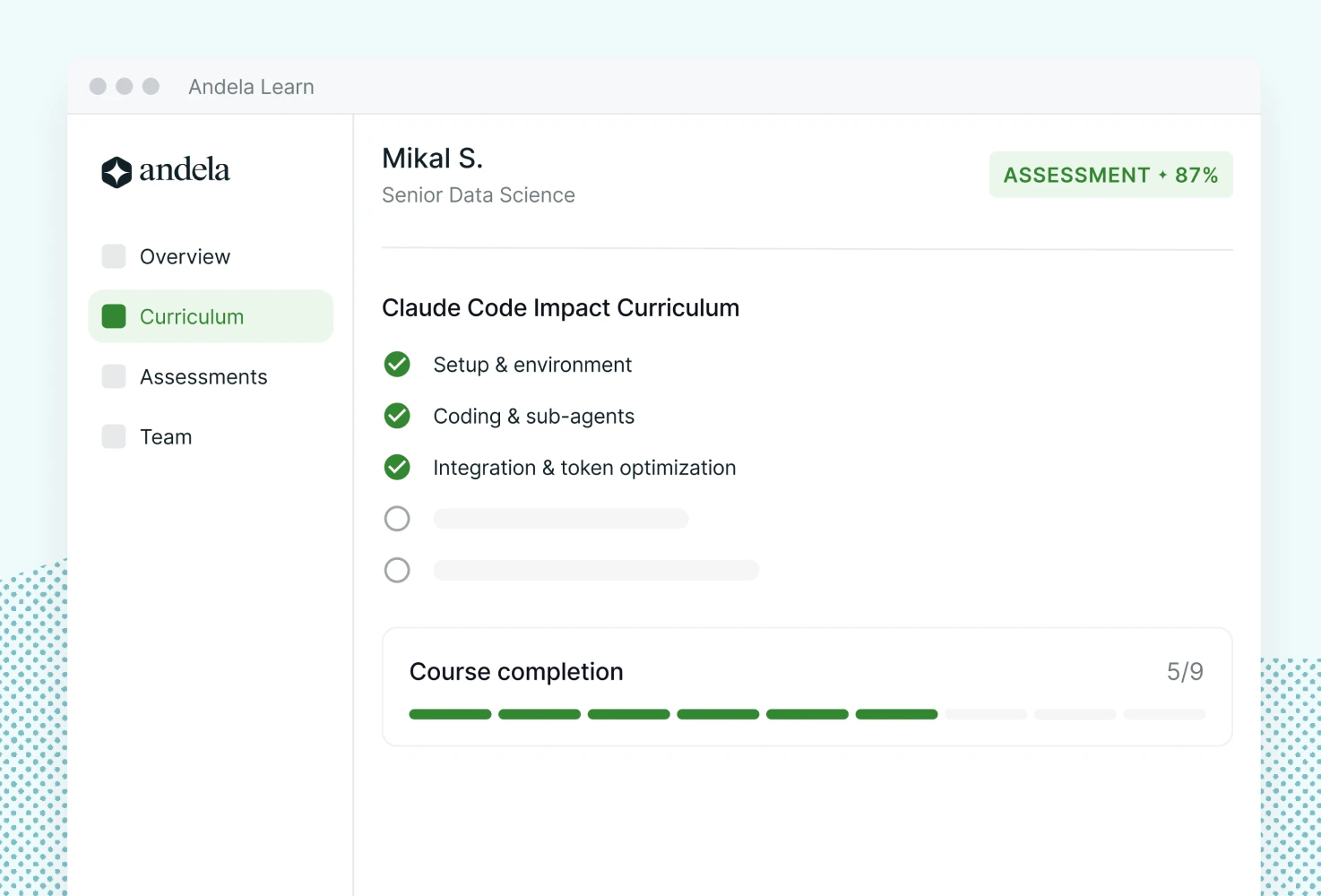
Build a live production system while enabling the team “in flight,” then validate performance against business outcomes.
- Build in the real codebase
- Move workflows into production
- Enable teams through delivery
Build consistent agentic use and the judgment to direct, verify, debug, refactor, test, and build simple agents.
- Automate repetitive tasks
- Accelerate individual workflows
- Build practical agent fluency
Apply advanced agentic engineering capabilities, including orchestration and multi-agent patterns, to more complex individual workflows.
- Connect agents across workflows
- Coordinate multi-step work
- Scale human + agent collaboration
Build a live production system while enabling the team “in flight,” then validate performance against business outcomes.
- Build in the real codebase
- Move workflows into production
- Enable teams through delivery
We enable on your stack:

What could better agent proficiency be worth?
Choose how many engineers to train. Results update instantly and represent a 12-month modeled return.
Explore each program in depth
A deep-dive of Adopt, Impact, and Transform agentic engineering programs.
- Delivery: A real business or engineering priority moves
- Capability: Build individual and systems capability by
Building agentic-first engineering practices
Andela helps enterprises redesign how people, AI tools, workflows, and systems come together across the enterprise.




FAQs
Andela Learn’s agentic engineering programs help enterprise engineering teams build agentic capability through applied, assessment-led learning.
Programs progress across three levels:
- Adopt: Foundational individual agent use
- Impact: Complex agent orchestration
- Transform: Build and deploy production AI solutions in a real codebase
Engineers learn by doing realistic or live engineering work, with expert-led instruction and learning tailored to assessed skill gaps. At the Transform level, enablement is embedded directly into solution delivery.
Programs can be delivered on: Claude Code, GitHub Copilot, and OpenAI Codex.
Andela Learn’s agentic engineering programs are built for enterprise engineering teams that have already invested in AI coding tools, but aren’t yet seeing meaningful adoption.
Many teams are still using AI primarily for autocomplete, code suggestions, or one-off prompting. These programs help engineers move beyond shallow usage and apply agents to more complex, higher-value engineering work.
They’re designed for:
- Engineering teams ready to move from basic AI assistance to agentic workflows
- CTOs, CIOs, and engineering leaders accountable for adoption, productivity, and ROI
- HR and L&D leaders responsible for building the skills needed to sustain that change
The goal is meaningful adoption that changes how engineering work gets done.
There are three levels, based on how advanced the team’s agentic capability is and how directly the work connects to production:
Adopt: Foundational individual agent use
Designed for teams that have access to AI coding tools but see shallow adoption, such as autocomplete, code suggestions, or simple prompts. Engineers build consistent day-to-day agent use and the judgment to direct, verify, debug, refactor, test, and safely apply AI-generated work.
- Outcome: stronger individual workflows, practical fluency, and more meaningful adoption.
Impact: Complex agent orchestration & workflows
Designed for engineers ready to move beyond individual agent use into more advanced patterns. Teams learn to coordinate agents across multi-step workflows, use sub-agents and orchestration, manage context and token usage, and apply agents to more complex engineering work.
- Outcome: higher-value workflows, greater leverage from agents, and more sophisticated human + agent collaboration.
Transform: Production solution delivery
Designed around a real initiative from the customer’s roadmap, not a synthetic exercise. Andela works with the team to build and deploy a live AI solution in the customer’s real codebase, with enablement embedded throughout the engagement so engineers build capability alongside delivery.
- Outcome: a production AI solution, real business value, and a team better equipped to build the next one themselves.
An LMS gives engineers content to consume. Andela is designed to change how engineers work — and measure whether that change actually happened.
Instead of relying on self-paced videos, quizzes, and course completion, Andela combines:
- Assessment-led learning: Engineers are assessed first, so learning is tailored to the specific skills and gaps of the team.
- Applied engineering work: Engineers learn by solving realistic engineering problems in code, not by watching someone else do it.
- Live expert instruction: Practitioners teach, coach, and challenge engineers as they apply new agentic techniques.
- Progressive complexity: Teams advance from foundational agent use to orchestration, multi-agent workflows, and eventually production delivery.
- Built for your AI stack: Programs are built around the tools engineers actually use, including Claude Code, GitHub Copilot, and OpenAI Codex.
- Measured capability gains: Engineers are reassessed to show whether proficiency actually improved — not just whether they completed a course.
- Adoption measurement: We look beyond learning completion to whether engineers are using these capabilities in their day-to-day work.
- Production application: At the Transform level, learning moves into the real codebase, with enablement embedded directly into solution delivery.
The difference is the outcome: an LMS can tell you who finished a course. Andela helps you determine whether engineers can actually work differently with AI — and whether that capability is showing up in the business.
Applied learning means engineers build capability by doing the work, not just studying it. The learning cycle is: Learn it, apply it, get feedback, and prove you can use it in the work.
Our programs follow the 70 / 20 / 10 model:
- 70% learning through real work: Engineers work through realistic engineering tasks — debugging, refactoring, shipping pull requests, orchestrating agents, and solving complex workflow problems.
- 20% learning with others: Live experts provide coaching, feedback, code review, and guidance as engineers apply new techniques.
- 10% formal instruction: Short, focused, and live instruction introduces the concepts, patterns, and practices engineers need before putting them to work.
Synthetic, brownfield code-base: In Adopt and Impact, that work happens in an enterprise-grade practice codebase designed to reflect real engineering complexity.
Real, production code-base: In Transform, it moves into the customer’s real codebase and live initiative, with learning embedded directly into delivery.
The programs support GitHub Copilot, Claude Code, and OpenAI Codex.
Every program runs on one agentic engineering curriculum, and you choose your team's tool at scoping. The concepts stay the same across tools: the hands-on labs, integrations, and guardrails are built for the one you choose.
- GitHub Copilot: Engineers move past autocomplete to working with Copilot's agent modes and the Plan Agent, and set team standards in copilot-instructions.md. They use the Copilot coding agent to take an issue to a pull request with passing tests. They connect Copilot to docs and data through Skills, extensions, and MCP, and use Copilot's review agent to catch bugs that got past the first round of tests. They also compare models to see how model choice affects token use.
- Claude Code: Claude Code runs in the terminal with access to files and the shell, so this track starts with safe autonomy. Engineers set permissions that decide what the agent can run without asking, add hooks that enforce checks, and block destructive commands. They write lean CLAUDE.md files, build reusable slash commands and skills, delegate work to sub-agents, and connect Jira, docs, and databases through MCP. They use the Claude GitHub app to go from issue to pull request. In Impact, they run Claude Code headless in CI and build multi-agent pipelines.
- OpenAI Codex: Engineers work across the Codex CLI, the IDE extension, and Codex Cloud, and learn which one fits which job. They write AGENTS.md files and set the right approval mode and sandbox level before a task starts. They use plan mode to review the agent's approach before it builds. They run tasks in parallel in isolated Codex Cloud sandboxes, then review and merge the results. They use @codex review on pull requests and control cost by tuning reasoning effort.
Across all three: Engineers build the same core skills: writing context files, planning before building, spec-driven and test-driven development, delegating from ticket to pull request, connecting tools through MCP, controlling token costs, and following safe-use guardrails. Assessments use a shared question bank across tools, so results stay comparable even when different teams use different tools.
Adopt is the foundational program for working software engineers, typically mid-level and above, who are ready to move from basic AI assistance to consistent, day-to-day agent use.
- Format: Two-day intensive or two-week program, with approximately 8.5–10.5 hours of learning
- 6 modules: Hands-on learning across agent setup, coding with sub-agents, token management, ticket-to-pull-request delegation, data and SQL workflows, and backlog triage
- Capstone Project: Each engineer completes a practical capstone and presents and defends their approach
- Outcome: Engineers leave with the judgment and practical fluency to use agents more consistently across everyday engineering work
Impact is the advanced program for engineers who already use AI agents consistently and are ready to apply them to more complex, multi-step engineering workflows.
- Format: Live, expert-led applied learning built around increasingly complex agentic engineering work
- 9 modules: Advanced practice across sub-agents, orchestration, multi-agent workflows, integrations, context and token optimization, and end-to-end workflow execution
- Capstone Project: Engineers complete and defend a complex agentic workflow that brings multiple techniques together
- Outcome: Engineers leave able to orchestrate agents across more complex engineering work and get greater leverage from AI beyond individual tasks
Transform is a solutions-led engagement where Andela delivers a real initiative from the customer’s roadmap while customer engineers build AI-native capability alongside the delivery team. Unlike Adopt and Impact, the work happens in the customer’s real codebase and production environment, not a synthetic one.
- Format: Project-based engagement scoped around the complexity and requirements of a real production initiative
- Real initiative: Andela and the customer select a well-scoped roadmap priority—such as modernization, a new feature, AI workflow, migration, or targeted technical debt
- Embedded enablement: Customer engineers work alongside Andela through hands-on delivery, coaching, mentoring, working sessions, and exposure to AI-native delivery practices
- Outcome: A real solution gets delivered, while the customer team builds the capability and practices to apply this way of working again
No, the journey is not a fixed sequence. Teams start based on their current capability, gaps, and the work they need to do.
- Assessment identifies the baseline: Andela evaluates current skills and agentic proficiency to show where capability is strong and where gaps exist.
- Learning paths are individualized: Engineers can be routed into Adopt, Impact, or Transform based on what they actually need—not a one-size-fits-all curriculum.
- Teams can split by readiness: A more advanced cohort may move directly into Transform while others build foundational or orchestration skills through Adopt or Impact.
- Impact & Transform do not require prior completion: Teams with a capable group and a well-scoped production initiative can enter Transform directly.
The goal is to meet each engineer and team where they are, then build the shortest path to meaningful capability and production impact.
Assessment isn’t a one-time test. It runs before, during, and after learning to personalize the experience, measure capability growth, and determine whether new skills translate into sustained adoption.
- Baseline assessment: Establish each engineer’s proficiency, identify skill gaps, and create a tailored learning path. We also align on relevant business KPIs and current tool adoption.
- During the learning stage: Track how engineers progress through tailored curriculum, hands-on work, and expert-led instruction — including completion, engagement, drop-off, and perceived relevance.
- Exit assessment: Reassess engineers to quantify capability growth, including score improvement, mastery attainment, and gains by starting proficiency.
- 30/60/90-day adoption pulse: Look beyond learning to determine whether the change sticks — tracking activation, frequency of use, workflow adoption, productivity signals, barriers, and manager feedback.
The result is a report on what the team learned, where capability improved, and whether they’re actually working differently afterward.
Andela’s applied learning programs are designed to produce measurable gains in proficiency, practical agentic judgment, and adoption — not just course completion.
Recent Andela research with 41 professional engineers found that after two weeks of structured agentic learning:
- +11.6 percentage points in average proficiency, moving from about 69% to 81%
- +39 points in understanding execution and sandbox constraints
- +31.7 points in repository-guidance practices
- +26.8 points in defining verification criteria
The largest gains came from: engineers with the biggest initial skill gaps, reinforcing the value of assessing first and tailoring learning accordingly Andela Applied learning can materially improve how engineers work with agents — especially the operational skills required to move beyond basic AI use. The study measured scenario-based proficiency rather than downstream production performance, which is why Andela’s broader model also tracks adoption and business outcomes after learning.
We estimate ROI by combining your organization’s economics with observed research on AI productivity and Andela learning outcomes.
The model works in four steps:
- Start with your organization: Number of engineers trained, annual loaded cost per engineer, and total program investment.
- Establish the AI productivity baseline: The model uses a 26.08% productivity benchmark from randomized field experiments with 4,867 software developers using AI coding assistants.
- Apply the proficiency gain: Andela research found a 16.8% relative increase in agentic proficiency after its foundational program. Applied to the productivity benchmark, that models an additional 4.38 percentage points of productivity capacity.
- Value what the business can actually capture: You choose how much of that added capacity can realistically be converted into productive work. The calculator then estimates annual value, first-year ROI, payback period, and value per engineer after program costs.
Andela’s ROI calculator is designed as a business-case estimate, not a guarantee of production impact. During an engagement, the model can be paired with your actual adoption and engineering data to evaluate whether that value is being realized in practice.
AI transformation is not just a technology rollout — it requires CIO and CHRO organizations to change skills, behaviors, roles, and workflows together. Yet Gartner research highlighted in Andela’s analyst work found that only 38% of CIOs and CHROs share an understanding of how AI will change work.
Andela Learn’s agentic engineering programs give CHRO/People/HR/L&D and technology leaders a shared system for managing that change:
- Create a common baseline: Assess what engineers can actually do with AI today and identify capability gaps across the workforce.
- Target the right interventions: Tailor learning paths by proficiency rather than giving every engineer the same training.
- Connect skills to work: Build capability around the workflows, roles, and behaviors that engineering leaders are trying to change.
- Measure behavior change: Track proficiency, adoption, and 30/60/90-day signals to see whether new skills are showing up in day-to-day work.
- Give CIO and CHRO teams a shared scorecard: Connect workforce capability to technology adoption and business outcomes so both functions can manage transformation together.
The goal is to move AI enablement from an L&D initiative to a shared workforce and technology transformation program. This matters because the same research shows that while 71% of CIOs say their workforce is unprepared for AI, only 29% feel confident modernizing that workforce and just 16% feel confident redesigning AI-driven processes.
It depends on the program. The environment becomes progressively more real as teams move from Adopt → Impact → Transform.
- Adopt: Engineers work in their own sandbox using Andela’s enterprise-grade practice codebase. No production access is required.
- Impact: Engineers continue working in a controlled practice environment, but on more complex, multi-step and orchestrated agent workflows. Capstone work can be adapted to customer repositories where appropriate and approved.
- Transform: Work moves into the customer’s real codebase and production environment. Andela and the customer agree upfront on access, security, governance, and delivery controls.
Across all three, safe AI use is built into the experience, including scoped permissions, human approval for higher-risk actions, and controlled access to systems and data.
Mostly access, data, sponsorship, and protected time. Andela runs the program end to end; your team provides the inputs needed to make the learning relevant and measure impact against your own baseline.
- AI tool access: Seats for each learner, with usage visibility enabled and any security, proxy, or terminal restrictions identified before kickoff.
- Usage and engineering data: Access to relevant telemetry or analytics so we can baseline adoption and track changes in activation, frequency, and usage over time.
- An executive sponsor: An engineering or transformation leader who owns the adoption or productivity goal and helps keep the program connected to business outcomes.
- Protected learner time: Dedicated time for live sessions, applied practice, and capstone work.
- Your engineering standards: Relevant security policies, development practices, and pull-request conventions so the experience reflects how your team actually works.
- Manager participation: Brief input during follow-up to help assess whether new behaviors are showing up in day-to-day work.
For Transform, you also bring a real roadmap initiative, a small group of engineers who will work alongside Andela, the relevant business or technical SMEs, and access to the production environment. The engagement begins with a scoped inception phase to align on outcomes, roles, security, quality standards, and the delivery plan.
Andela provides the learning experience, expert support, delivery infrastructure, and measurement system needed to run the engagement from baseline through sustained adoption.
- Assessment and reporting: Entry and exit assessments, learner and cohort-level results, adoption measurement, and 30/60/90-day follow-up.
- Expert-led delivery: Facilitators, technical experts, and program support to guide engineers through live learning and applied work.
- The learning environment: Individual sandboxes, enterprise-grade practice codebases, prepared datasets, and realistic engineering scenarios where applicable.
- Curriculum and applied exercises: Self-paced content, live instruction, worked examples, templates, labs, and hands-on practice tailored to the AI tools your team uses.
- Capstones and evaluation: Practical capstone work, scoring frameworks, and structured feedback to demonstrate applied capability.
- Ongoing support: Community access, coaching, feedback, and office hours where appropriate to help engineers apply what they are learning.
For Transform, Andela also provides the solution delivery team, technical leadership, and AI-native delivery practices required to move the selected initiative forward while capability is transferred to the customer team.
Andela manages the experience from baseline through sustained adoption, so learning doesn’t stop when the sessions end.
- Assess: Establish current agentic proficiency, tool usage, capability gaps, and relevant business or engineering baselines.
- Personalize: Use assessment results to place engineers in the right program and tailor learning to their tools, workflows, environment, and gaps.
- Prepare: Configure sandboxes and tooling, resolve access issues, confirm telemetry and measurement, and make sure engineers are ready before kickoff.
- Learn by doing: Engineers build capability through live expert instruction, hands-on engineering work, feedback, and capstone projects. In Transform, this happens through delivery of a real production initiative.
- Measure capability: Exit assessments and capstone performance show what engineers learned and where proficiency improved.
- Track adoption: 30-, 60-, and 90-day follow-ups measure whether new behaviors are carrying into day-to-day engineering work.
- Evaluate impact and scale: Compare results against the original baseline, identify what is working, and decide where to expand, refine, or move teams to the next level.
Every program starts from a proven core curriculum and assessment framework. During scoping, we tailor the experience to your AI tools, engineering environment, team baseline, and business priorities—while keeping outcomes measurable across cohorts.
- AI tools: Programs can run on GitHub Copilot, Claude Code, or OpenAI Codex. Labs, demonstrations, integrations, setup guidance, and guardrails are adapted to the tool your engineers actually use. Teams using multiple tools can run separate tracks against the same assessment framework.
- Engineering environment: Practice can happen in Andela’s enterprise-grade sandbox or, where appropriate, your own repositories. Labs can reflect your languages, stack, workflows, security policies, review processes, and integrations.
- Assessment baseline: Every engineer is assessed before the program. Results identify proficiency gaps, inform individualized learning paths, and help determine whether engineers are best suited for Adopt, Impact, or Transform. Adoption and relevant business metrics can also be baselined before learning begins.
- Curriculum: Facilitators adjust emphasis based on your team’s needs—from code review and legacy modernization to agent orchestration, data workflows, testing, or cost optimization. Delivery format, language, and supporting workshops can also be adapted.
- Team standards: Engineers practice using your conventions, including context files, pull-request standards, model-selection guidance, and safe-use policies.
- Bespoke needs: For highly specific technologies, industries, or outcomes, Andela can scope a custom program using the same applied-learning and measurement framework.
Proven at scale & track record
Andela brings more than a decade of experience building technical capability across global engineering organizations.
- 12+ years of applied technical learning and workforce enablement
- 200,000+ technologists trained
- 5.6M+ technologists represented in Andela’s global talent ecosystem
- 4,000+ mapped technical skills in our living skills taxonomy, informing assessment and learning
- Deep technology partnerships including GitHub, Google, Microsoft, AWS, Meta, NVIDIA, OpenAI, and Anthropic
- Global practitioner network of technical experts and facilitators who understand how engineering work happens in practice
Built for measurable adoption
Andela Learn is designed to change how engineers work with AI—not simply deliver training content.
- Assessment-led: Start with individual proficiency and skill gaps, then tailor the learning path
- Applied by design: Engineers build capability through hands-on engineering work, not passive instruction
- Expert-led: Live practitioners coach, challenge, and provide feedback as engineers apply new techniques
- Built around your environment: Adapt to your AI tools, stack, workflows, standards, and security requirements
- Measured beyond completion: Track capability growth, tool adoption, and 30/60/90-day behavior change
- Connected to production: Progress from synthetic enterprise environments to real codebases and solution delivery through Transform
Pricing reflects how each program is delivered:
- Adopt and Impact: priced per learner
- Transform: priced by project scope
Final pricing is confirmed during scoping based on your team size, delivery needs, environment, and goals. See below for more on what can affect pricing.
Adopt and Impact: priced per learner
Adopt and Impact are cohort-based programs, typically delivered to groups of around 50 engineers. Pricing scales based on the number of learners and cohorts. AI coding tool licenses are not included. Your organization provides seats for GitHub Copilot, Claude Code, or OpenAI Codex. The per-learner price includes:
- Live, expert-led instruction and self-paced learning
- Individual sandbox environments and practice codebases
- Facilitators, technical support, and change-management support
- Entry and exit assessments
- Capstone evaluation
- Cohort and learner-level reporting
Transform: priced by project scope
Transform is priced differently because it is a solutions engagement with enablement embedded into delivery, not a training program. Pricing depends on the scope, complexity, environment, and delivery requirements of the initiative. Engagements typically begin with a scoped inception phase to define:
- The business and engineering outcome
- Scope and definition of done
- Roles and working model
- Environment, access, and security requirements
- Quality and delivery standards
- The plan for the broader engagement
What affects pricing?
Pricing can vary based on:
- Number of learners and cohorts
- Program selected
- Environment and tooling requirements
- Level of curriculum or lab customization
- Reporting and measurement needs
- Additional workshops or bespoke content
We help connect learning investment to the economic value of changing how engineers work with AI.
The ROI calculator provides an initial 12-month estimate using inputs such as:
- Number of engineers
- Fully loaded engineering cost
- Program investment
- Expected AI-enabled productivity improvement
- How much of that additional capacity the organization can realistically capture
From there, we refine the business case during discovery using your own assumptions, baseline data, and the outcomes that matter to your organization.
The goal is to measure value at multiple levels:
- Capability: Are engineers measurably more proficient?
- Adoption: Are they actually using AI more frequently and in more advanced workflows?
- Engineering performance: Are relevant measures such as cycle time, throughput, or cost per task changing?
- Business value: Is the organization converting those improvements into meaningful capacity, speed, cost savings, or delivery outcomes?
The calculator establishes the hypothesis. Your baseline and post-program results help determine whether that value is actually being realized.
Yes. The programs are designed so organizations can prove the model with a focused group before scaling across the enterprise.
- Start with one cohort: Run Adopt or Impact with a representative group of engineers and establish a clear baseline before learning begins.
- Measure before expanding: Compare changes in proficiency, adoption, workflow behavior, and agreed engineering metrics against that baseline.
- Learn what works: Use the first cohort to identify where engineers are progressing, where adoption is getting stuck, and what needs to change before a broader rollout.
- Scale based on evidence: Expand to additional teams, cohorts, tools, or program levels once you know which interventions are driving results.
- Start with one real initiative: For Transform, organizations can begin with a single well-scoped roadmap project before moving into additional production initiatives.
This creates a test → measure → refine → scale approach rather than requiring a large enterprise-wide commitment upfront.
Getting started begins with understanding where your team is today and what you want to change. The goal is to start with evidence, not assumptions — then build the right path for the team.
- Discovery: We align on your goals, current AI tooling, engineering population, adoption challenges, timeline, sponsorship, and any security or operating constraints.
- Assessment: Engineers complete a baseline assessment to identify current proficiency, skill gaps, and variation across the team.
- Starting-point recommendation: Assessment results help determine who should begin with Adopt, Impact, or Transform — and whether different groups need different paths.
- Scoping: We confirm the program, cohort structure, AI tool, customization, success measures, data requirements, and delivery cadence.
For Transform, scoping also includes selecting the production initiative and aligning on scope, roles, access, security, quality standards, and the delivery plan.