
















Build the systems AI needs to work in production



Modernize the foundation. Operationalize AI.
From modernizing technology and data to building production AI systems, Andela helps enterprises put AI to work across their systems and workflows.
Move legacy systems to AI-ready platforms
Reduce technical debt, improve performance, and build the foundation for faster, AI-enabled innovation.
Application modernization
Modernize legacy applications for better scalability, maintainability, and performance.
Migrate critical workloads and infrastructure with minimal disruption.
Modernize the tools and workflows engineers use to build and ship software.
Prepare enterprise data for AI
Build the trusted data foundation AI needs to deliver value across the enterprise.
AI data ingestion & preparation
Prepare enterprise data for AI by structuring, migrating, and optimizing it for modern AI workloads.
Structure and label datasets so models can retrieve, interpret, and learn from them.
Align AI models to business workflows & constraints
Connect AI to trusted enterprise knowledge
Ground AI in the knowledge, permissions, and context of your business.
Connect enterprise sources
Connect information spread across documents, systems, and teams.
Ensure enterprise knowledge is accessed securely, with full auditability and compliance
Continuously improve retrieval accuracy, relevance, and performance for production AI systems.
Redesign workflows with AI agents
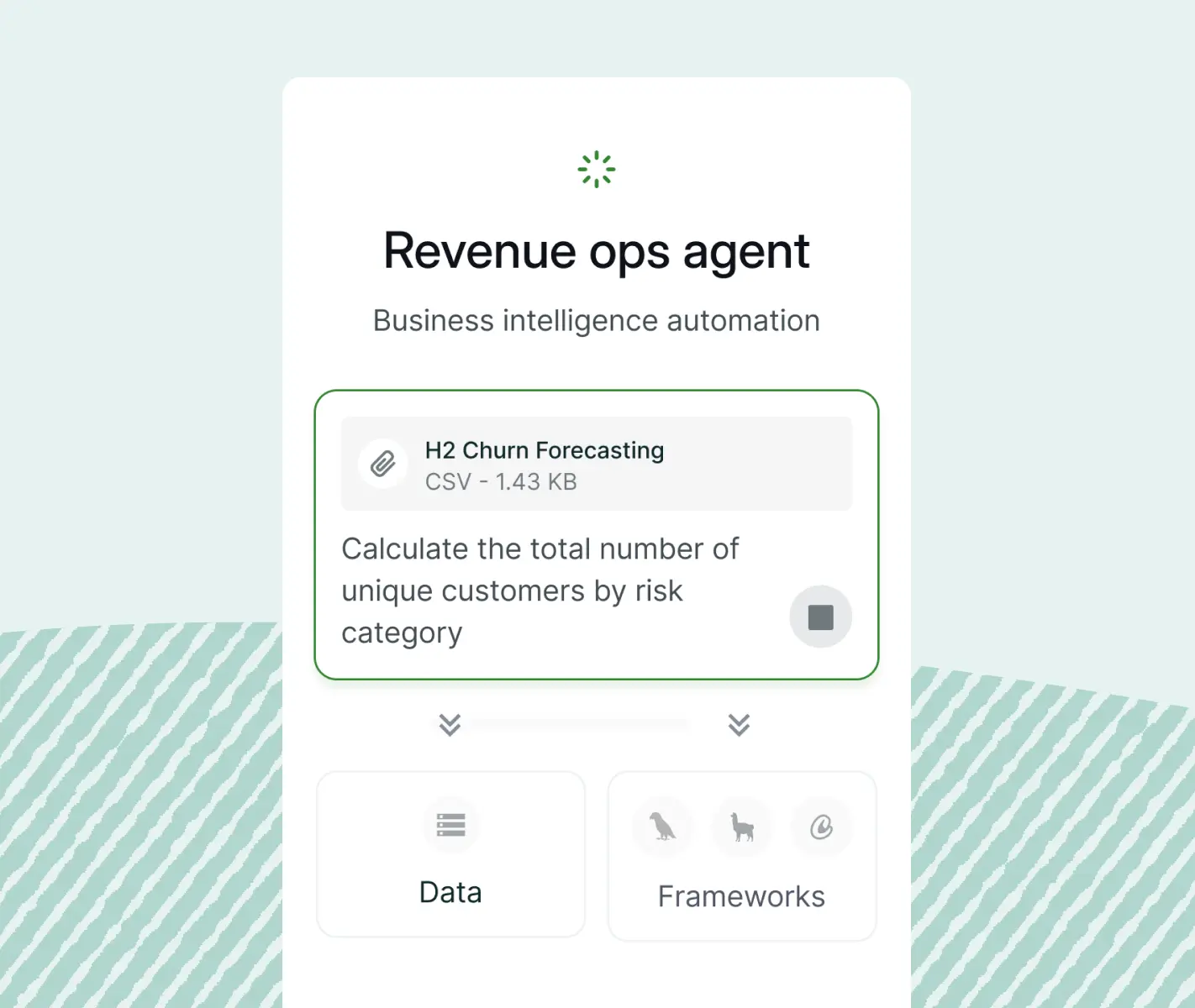
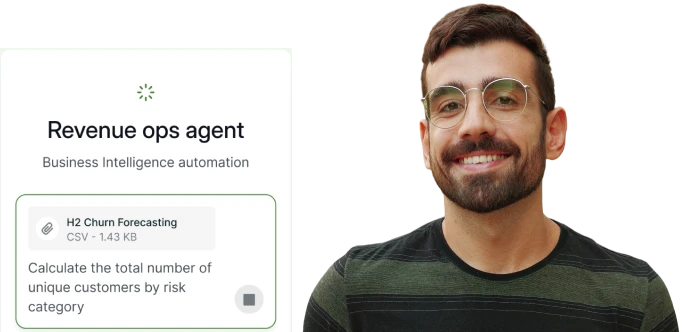
Transform manual and fragmented processes into governed agentic workflows with controls, integrations, and human oversight.
Application modernization
Modernize legacy applications for better scalability, maintainability, and performance.
Design workflows that coordinate agents, tools, systems, and people across end-to-end business processes.
Deploy agentic workflows with the controls, observability, and optimization required for reliable production use.
Building agentic-first engineering practices
Andela helps enterprises redesign how people, AI tools, workflows, and systems come together across the enterprise.






Build the capabilities behind successful AI delivery
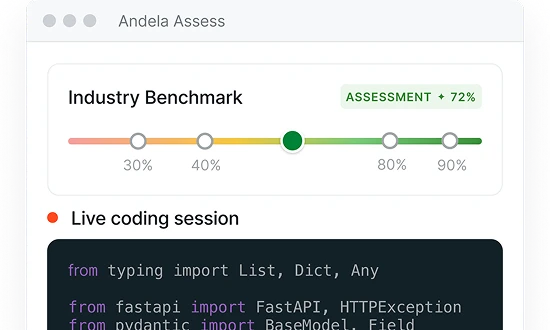
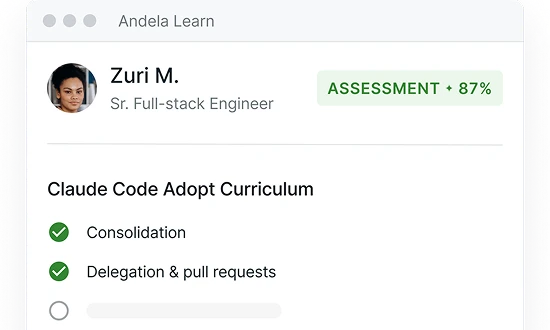
Assess your team's AI capabilities and build proficiency through applied learning, before or alongside solution delivery.
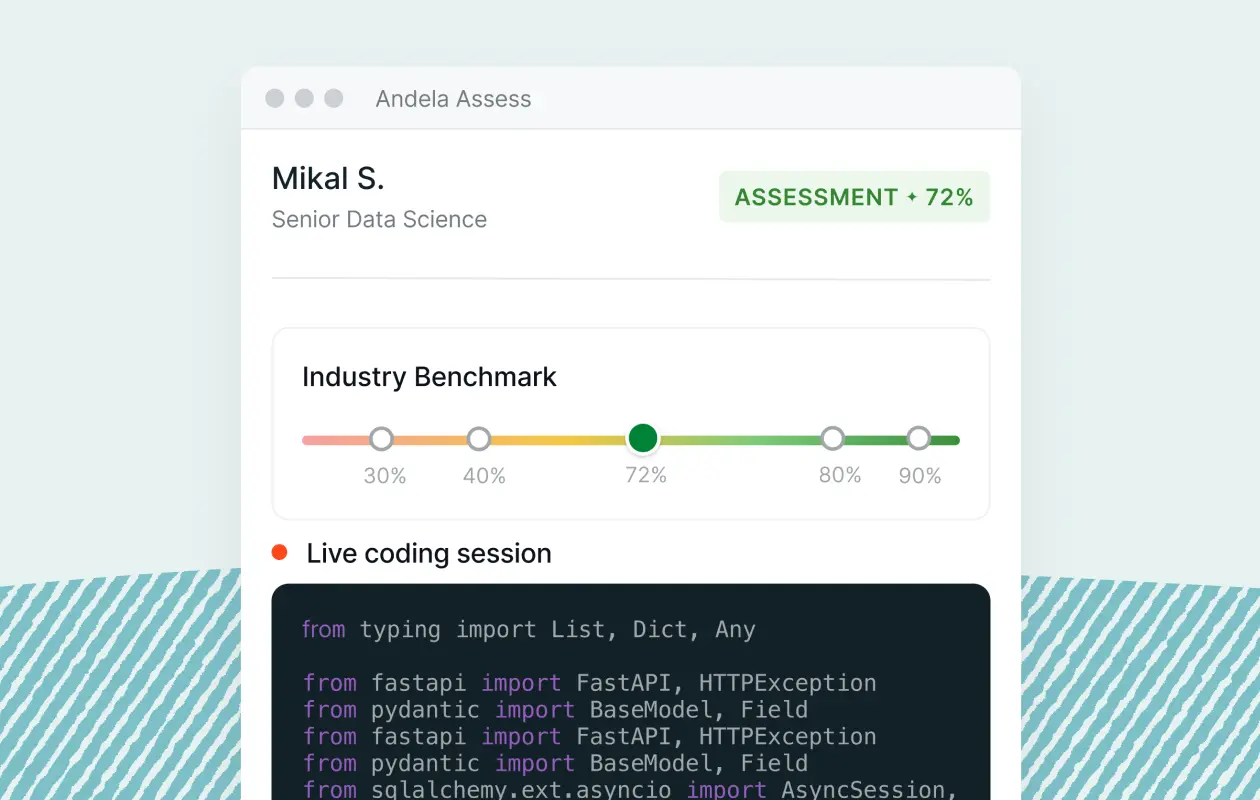
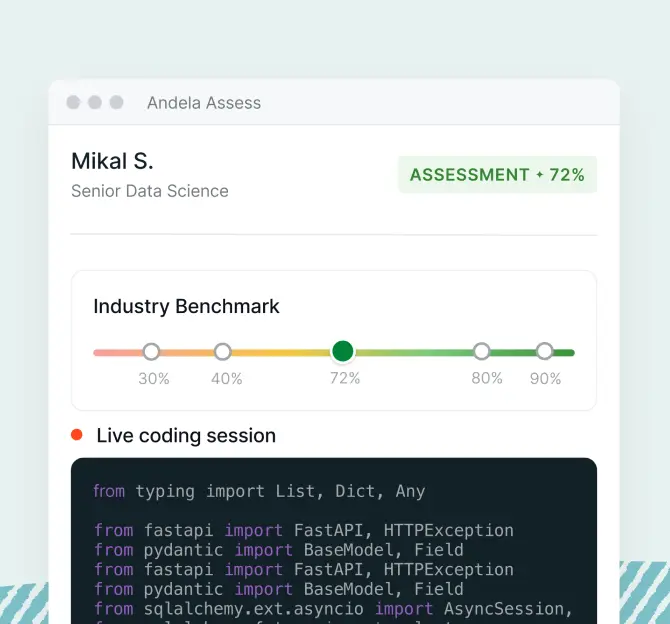
Measure how engineers actually work with AI, where capability breaks down, and what will help teams move forward.
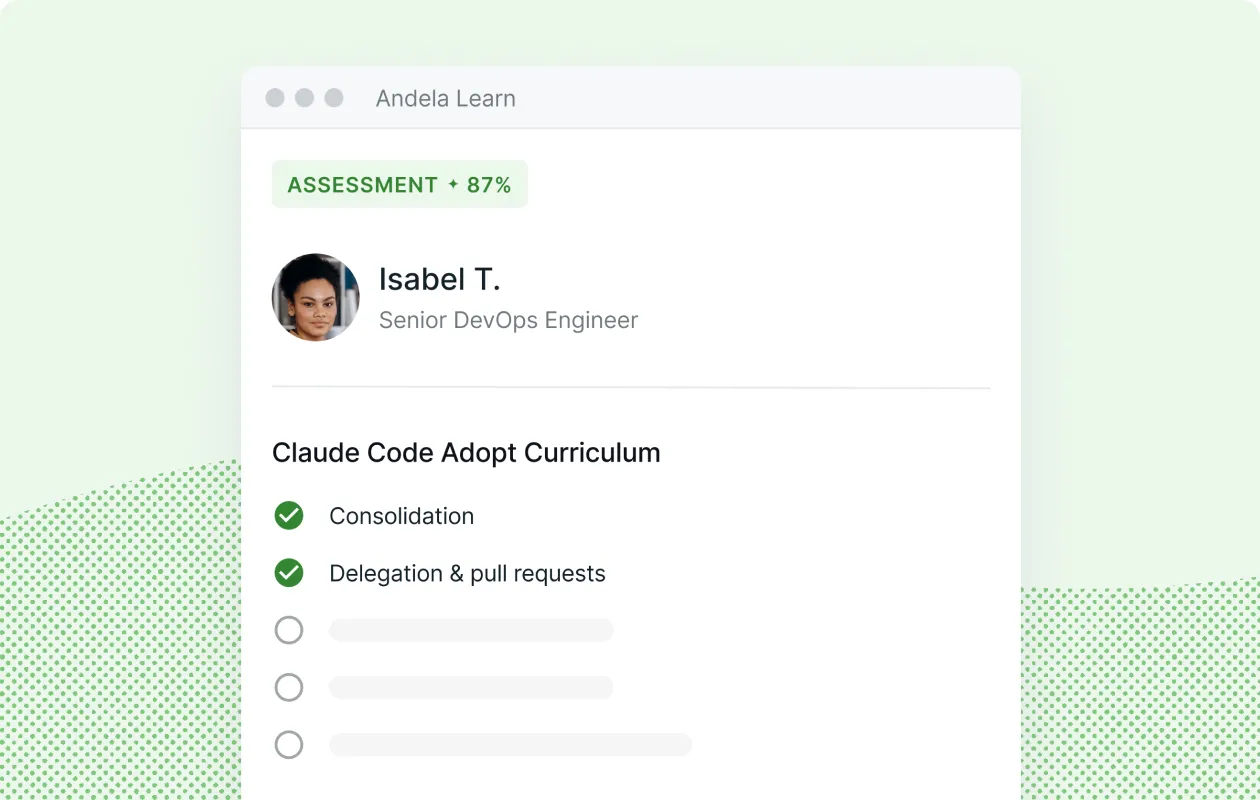
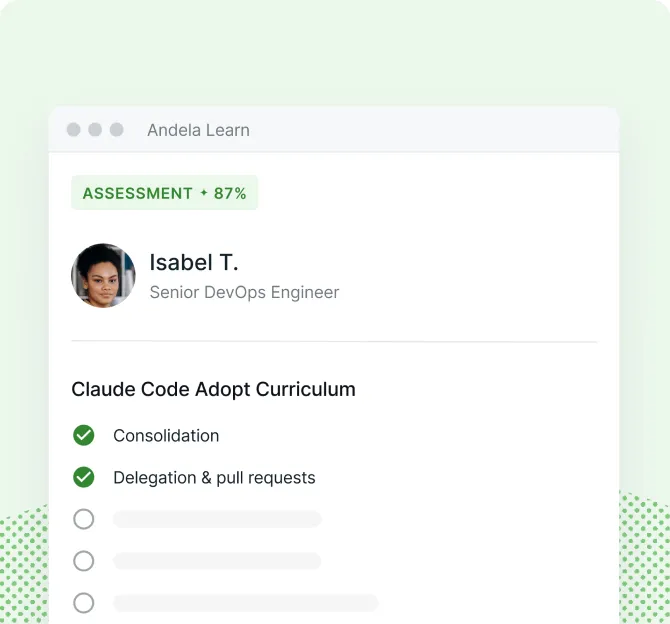
Build proficiency through applied learning tied to real engineering workflows, from AI-assisted development to multi-agent orchestration.
FAQs
Andela’s AI solutions build the foundations and systems enterprises need to run AI in production. Andela takes ownership of a defined outcome, such as a modernized platform, a trusted data foundation, an enterprise knowledge assistant, or an agentic workflow, and delivers it end to end.
The work spans two areas:
- AI foundations: Modernize the systems and data AI depends on, through Modernization & migration and Data foundations.
- AI systems: Build production AI grounded in enterprise knowledge and connected to real workflows, through Enterprise knowledge search and Agentic workflow transformation.
Every solution follows an Andela playbook, has governance built in from day one, and is delivered so your team can operate, extend, and build on it.
Andela’s AI solutions are built for medium and large enterprises that have a business goal, a deadline, and pressure to show AI value, but limited capacity, expertise, or clear ownership to deliver it.
They’re designed for:
- CIOs, CTOs, and technology leaders who need a critical AI outcome delivered and want a partner accountable for it
- Engineering, data, and AI leaders whose pilots are stuck short of production, or whose systems and data aren’t ready to support AI at scale
- Business and operations leaders with manual, slow, or costly processes that AI agents could take on, with people still in control of key decisions
Teams can start wherever they are, from choosing a first use case to improving and scaling AI that’s already running.
Bring in Andela when an AI outcome matters and your team doesn’t have the capacity, specialist skills, or delivery ownership to get there on time. Common signals:
- A deadline your roadmap can’t absorb: A critical AI initiative needs to ship, but your engineers are committed elsewhere.
- Specialist skills you’d have to hire: The work needs expertise such as retrieval pipelines, evals, LLMOps, or AI security, which can take months to recruit.
- Pilots that won’t scale: Prototypes work, but production readiness, cost, or governance are still open questions.
- No clear owner: Leadership needs one partner accountable for delivering the result.
When you have the people, skills, and time, building in-house can be the right call, and Andela Assess and Andela Learn can help your engineers get there. Many teams do both: Andela delivers the first solution while their engineers build the skills to own the next one.
Andela owns the outcome. With Andela’s AI solutions, Andela scopes, staffs, and runs the work against agreed deliverables, and is accountable for the result.
How that compares with other models:
- Staff augmentation: You add people. Your team directs the work and owns delivery.
- AI consulting: A firm sets direction and builds the roadmap. Delivery happens separately.
- Andela AI solutions: Andela delivers the outcome, keeps the work visible to you throughout, and builds your team’s capability along the way.
Andela also works alongside strategy and consulting firms. When a partner already owns the roadmap, Andela brings the technical AI expertise and implementation capacity to deliver it.
If you’d rather direct the work yourself, Andela can embed vetted technical talent in your team instead. Discovery starts by confirming which model fits.
Andela moves critical legacy applications, platforms, and developer tooling to modern, AI-ready environments, reducing technical debt and improving performance along the way. Modernization & migration is part of Andela’s AI foundations work.
- Application modernization: Legacy application and architecture assessment, refactoring and replatforming of critical applications, and modern API, microservices, and cloud-native architectures.
- Cloud & platform migration: Migration planning; workload, infrastructure, and configuration migration; and post-migration validation, optimization, and stabilization, with minimal disruption.
- Developer platform & tooling modernization: Developer platform migrations, including Azure DevOps to GitHub; CI/CD and DevOps workflow modernization; and AI-ready developer tooling and engineering workflows.
- How it works: Analyze the current state of apps, code, data, and infrastructure; map the target architecture and sequencing; refactor, migrate, or rebuild with AI accelerators and delivery governance; then validate, optimize, and scale.
- Typical outcomes: Lower migration risk, faster modernization, and future-ready platforms.
Andela prepares enterprise data so AI systems have clean, structured, and governed data to work from across the enterprise. Data foundations is part of Andela’s AI foundations work.
- AI data ingestion & preparation: Legacy data assessment and AI readiness planning, ETL/ELT pipeline engineering across modern data platforms, and schema design and data quality optimization for AI workloads.
- Data annotation & enrichment: Semantic tagging and taxonomy development, data classification and labeling at scale, and data quality assessment and gap analysis.
- Data governance & compliance: Access controls and compliance guardrails, metadata management, data lineage, and auditability, so AI systems can be trusted in production.
- Model alignment: Supervised fine-tuning on enterprise task datasets, instruction tuning aligned to business workflows, and domain adaptation for regulated and specialized industries.
- How it works: Assess the readiness of your data, platforms, and workflows; clean, structure, and govern the data; design the architecture, access, and controls; then make it available to AI use cases.
- Typical outcomes: A readiness baseline, a trusted data foundation, and production-ready architecture.
Andela connects AI to trusted enterprise knowledge, turning information spread across documents, systems, and teams into permission-aware answers, assistants, and search experiences. Enterprise knowledge search is part of Andela’s AI systems work.
- Connect sources: End-to-end retrieval-augmented generation (RAG) systems, including vector databases, embeddings, and indexing; structured and unstructured document ingestion pipelines; and hybrid keyword and semantic search.
- Ground AI on trusted context: Role-based access control built into the retrieval layer, document-level permissions and audit logging, and PII redaction and compliance-aware data filtering.
- Optimize retrieval for production: Embedding strategy and vector index optimization, query rewriting and context window optimization, and continuous retrieval evaluation and relevance monitoring.
- How it works: Connect docs, apps, and repositories; index, chunk, and enrich the knowledge; retrieve grounded context; then deliver it through assistants, search experiences, and knowledge-driven workflows.
- Typical outcomes: Faster discovery, trusted answers, and scalable knowledge access.
Andela redesigns business workflows around AI agents, turning manual and fragmented processes into governed agentic workflows that run in production, with the integrations, controls, and human oversight they need. Agentic workflow transformation is part of Andela’s AI systems work.
- Identify high-value use cases: Workflow, SOP, and process analysis; bottleneck, exception, and handoff identification; and use case prioritization based on value, risk, and complexity.
- Design and orchestrate agentic workflows: Agent roles, responsibilities, and orchestration patterns; tool, API, and enterprise system integrations; and human-in-the-loop approvals and escalation paths.
- Govern and scale agents in production: Evaluation frameworks, guardrails, and failure testing; monitoring, tracing, logging, and auditability; and performance optimization and continuous improvement.
- How it works: Identify the workflows, SOPs, and decision points worth automating; design agent roles, decisions, and handoffs; automate tasks across systems with the right approvals; then monitor, evaluate, and improve.
- Typical outcomes: Faster cycle times, governed automation, and workflow transformation that scales.
The Applied AI Review is a structured review of an AI-enabled product, workflow, agent, or prototype you’ve already built. It typically takes two to four weeks and gives you an objective view of what’s working, what needs attention, and what to do next.
It’s a fit when production readiness is unclear, or when hallucinations, data exposure, latency, production load, or budget are raising concerns.
- What we review: Product and workflow fit; architecture and scalability; models and orchestration; cost and performance; reliability, evals, and safeguards; and observability and security.
- What we need: Your business goals, access to the existing system, and technical materials such as workflows, code, prompts, and usage data, plus time with key stakeholders.
- What you get: Executive findings, a maturity snapshot, priority recommendations, and a next-step roadmap that says whether to stabilize, optimize, scale, expand, or re-architect.
- A flexible focus: The review can go deeper on a single area, such as security architecture, when that’s the priority.
The review isn’t a formal regulatory or compliance certification. When it surfaces work to do, Andela can carry the recommendations into delivery through a follow-on engagement.
Andela works across model providers and platforms, starting with the ones your organization has already approved, and recommends alternatives where they would improve quality, cost, or control.
- Model providers: Partnerships with Anthropic and OpenAI, including Claude-native and OpenAI-native application delivery, plus open-source models hosted in your own environment when data can’t leave it.
- Cloud and data platforms: Delivery in major cloud environments, including AWS and Azure, and on modern data platforms such as Databricks.
- Developer platforms: A GitHub partnership, plus Azure DevOps to GitHub migrations and CI/CD and DevOps modernization.
- Enterprise systems: Integrations with the CRMs, ERPs, ticketing systems, knowledge bases, and internal APIs your workflows depend on.
Each solution playbook includes reference architectures and recommended toolchains, which are adapted to your stack during Inception.
Andela runs a structured process from first conversation to production, with a clear decision point before each commitment. It typically takes six to ten weeks to go from discovery to the start of the build, depending on your team’s availability and how much documentation exists at the start.
- Discovery (one to three 45-minute calls): We learn about the problem, your team, goals, delivery preferences, timeline, budget, and what’s driving the urgency.
- Technical evaluation (a 45-minute call): Solutions architects and technical managers review your environment, target architecture, constraints, and dependencies, then share a cost and timeline range.
- Proposal (a one-hour call): We review a high-level proposal together and agree on whether to move into Inception.
- Inception (two to four weeks): Andela’s architects and technical leads work with your team to validate scope, architecture, and workflows, then commit to cost, timeline, and scope.
- Kickoff (one to two weeks after Inception): The full team onboards, sets the communication cadence, and completes sprint 0 planning and environment setup.
- Build: Delivery runs in agile sprints, with sprint review demos about once a week, whenever there’s new functionality to show.
- After the first release: You choose whether to scale down to maintenance, keep building with Andela, or take the work in-house with a full handover.
Inception is a short, scoped engagement, typically two to four weeks, that reduces delivery risk by validating scope, budget, team size, and technical architecture before the build begins.
Andela’s architects and technical leads shadow your team, audit your technical environment, and map day-to-day workflows, usually through one to two hours of working sessions a day. Together, we look at where workflows break down, how the people who will use the solution work today, which undocumented processes and edge cases to plan for, and how dependencies, legacy systems, and integrations fit together.
At the end of Inception, you receive:
- A committed cost and timeline, replacing the earlier range
- A product requirements document (PRD)
- A technical design document (TDD)
- Wireframes
- A RAID log of risks, assumptions, issues, and dependencies
- A communications plan
If Inception surfaces no blockers and you accept the final proposal, the build begins.
Start with a contained, governed pilot, prove it against agreed success criteria, then harden and scale what works. Andela runs each step with you:
- Pick a contained use case: Scope one well-defined workflow or system, tied to a team that’s already in place.
- Agree on success criteria up front: Define together what success looks like, so the result can be judged against it.
- Build inside the guardrails: Work in an isolated environment with least-privilege access and full observability.
- Prove it quickly: Deliver an evidence-backed result that leadership can act on, as fast as the use case allows.
- Harden for production: Add the automated testing, evaluation, guardrails, monitoring, and cost controls that production use requires.
- Expand deliberately: Broaden access and move to the next workflow only once security, quality, and business value are proven.
If you already have a pilot that’s stuck, the Applied AI Review shows what to stabilize, optimize, or re-architect before you scale.
Your data stays yours. On every engagement, access is scoped, usage is controlled, and activity is auditable.
- Your environment: Data, code, and workloads stay in your approved systems and tenants, and are never copied out.
- Least-privilege access: People and tools can reach only the repositories, data, and environments the work requires.
- No model training: Your data and code are never used to train Andela’s models or any third-party model.
- Auditable delivery: Approved tools, separated environments, activity logging, and human oversight are standard.
- Confidentiality from the start: Andela usually signs an NDA with you before moving past discovery, so detailed conversations can happen openly.
Access, security, and governance requirements are agreed before the build begins, and the team works within your identity, access, and security policies.
Governance is built into delivery from the start. Controls scale with what the AI can see, what it can do inside your workflows, and the impact of being wrong.
Every engagement moves through the same five gates before it earns broader scope:
- Approve: Define the tools, users, approved use cases, and boundaries up front.
- Isolate: Start with a limited team, codebase, or non-production environment.
- Control access: Keep data, code, and credentials in approved environments, with least-privilege access only.
- Review and monitor: Review outputs, log activity, evaluate quality, and define escalation paths.
- Expand deliberately: Broaden access only once security, quality, and business value are proven.
Higher-exposure use cases, such as automated decisions on sensitive data, get stronger controls, including a formal risk assessment, human approval before action, and a full monitoring and audit trail.
Mostly context, access, and decisions. Andela runs delivery; your team provides what’s needed to scope the work well and keep it moving.
- A clear problem and goals: A short description of the problem, what success looks like, and what’s driving the timing.
- A decision owner: A primary point of contact for day-to-day decisions, plus the stakeholders who need to weigh in, such as security, legal, or finance.
- Existing documentation: Any PRDs, technical designs, roadmaps, architecture diagrams, or rough notes. These help, but aren’t required.
- Subject matter experts: Time from the engineering, product, and operations people who know the workflows, typically one to two hours a day during Inception.
- Access: Access to the relevant systems, environments, and tools, provisioned in line with your security policies.
- Feedback during the build: Participation in sprint reviews, so priorities and trade-offs are settled as the work progresses.
Andela provides the team, methods, and governance needed to deliver the outcome, and keeps the work visible to you throughout.
- A dedicated delivery team: Solutions architects, delivery and project leads, and engineers matched to the work, such as AI, data, MLOps, DevSecOps, full-stack, and QA engineers.
- Assessed specialists: Engineers come from Andela’s certified network of 17,000+ technologists and are matched on assessed skills, domain experience, and technology.
- Solution playbooks: Patterns and practices, reference architectures, toolchains, and delivery methods for each solution area.
- Clear-box delivery: Daily standups you’re invited to, weekly sprint reviews and demos, and success metrics defined and reviewed together.
- A proactive partner: Andela flags risks, trade-offs, and ways to save time or money early, and explains the cost and timing impact of any change in scope.
- Enablement: Coaching, pairing, and knowledge transfer so your team can operate and extend what’s delivered.
Yes. Andela builds with the expectation that your team will run, extend, and build on what’s delivered, and teaches as it builds.
- Shared delivery standards: Andela trains its own teams and yours against the same playbooks, so your engineers learn the patterns, architectures, and practices used in the build.
- Learning embedded in delivery: Your team builds skills through the real work, within the sprint, rather than in a separate training course.
- Pairing with AI-native engineers: Andela engineers work alongside yours while new workflows take hold, so practices transfer as the work ships.
- New ways of working: Andela helps define the skills and behaviors AI-enabled work requires, such as reviewing AI output, catching hallucinations, and integrating agents into workflows.
- Full handover: When you’re ready, Andela completes a full knowledge transfer, with no dependency created.
When building your team’s capability is a primary goal, Transform, part of Andela Learn, puts structured enablement at the center of a delivery engagement.
You own the code Andela builds for you. There’s no vendor lock-in, and you can change course at the end of any phase.
When a phase of development wraps up, you choose how to continue:
- Maintain: Scale down to a small team, typically two or three engineers, to keep the product running. This suits teams that have built what they need, have a gap in funding, or want to learn from the first version before building more.
- Keep building: Continue development with a team that already knows the product, working from a backlog scoped during the build.
- Take it in-house: Andela completes a full knowledge transfer and hands the work over to your team.
As each phase ends, Andela also helps you plan what comes next.
Andela’s AI solutions are measured by production outcomes. Recent engagements include:
- Agentic analytics: In a proof of concept for a major pet care brand, Andela deployed an AI analytics agent in the client’s AWS environment that answers natural-language questions across Redshift and GA4 data, cutting lead time on queries and answers by 99%, from days to minutes.
- Legacy modernization: For one of the world’s largest industrial manufacturing and technology companies, Andela rewrote a business-critical PowerBuilder and .NET desktop application with about 200 features as a modern web platform in seven months, using a strangler pattern to reduce risk and downtime.
- Agentic workflows: For a construction company running 200 to 240 projects a year, Andela built a single source of truth with AI agents that automate project setup, purchase orders, submittals, and change orders, cutting rework from 20% to under 5% and manual work from days to minutes.
- Enterprise knowledge: Working with a global consulting firm, Andela built a consumer intelligence proof of concept for a Fortune 100 pharmaceutical company in four weeks, cutting answer time from days to minutes using only approved data sources.
- AI adoption: Andela embedded engineers alongside a stalled Claude Code rollout, ran AI training before onboarding, and had more than 10 custom workflows live in eight days.
Every engagement starts by defining success criteria together, so results are measured against the goals that matter to your business.
Andela’s AI solutions are priced by scope. Each engagement is built around a specific outcome, so pricing reflects the work required to deliver it.
- A range before you commit: After the technical evaluation, Andela shares a calibrated cost and timeline range so you can judge feasibility early.
- A committed price before the build: Inception replaces the range with a committed cost and timeline.
- Billing tied to milestones: Invoices follow delivery checkpoints, so spend tracks progress.
- Clear change control: When priorities shift, Andela explains the cost and timing impact and offers options, including swapping scope where possible.
What affects pricing?
- Scope and complexity of the solution
- Your environment, integrations, and legacy dependencies
- Security, compliance, and governance requirements
- Timeline and team size
- How much enablement and knowledge transfer you want built in
The Applied AI Review is priced separately, based on the scope of the system under review.
Andela connects assessment, applied learning, and solution delivery, and each offering leads into the next. You can start with whichever one fits your needs today.
- Andela Assess: Measures how engineers work with AI and where capability breaks down. Results show where enablement or added delivery capacity would help most.
- Andela Learn: Builds the skills and judgment engineers need to work with AI through applied programs. Transform, its most advanced program, embeds enablement directly into the delivery of a real production initiative.
- Andela Deploy: Builds the AI foundations and AI systems enterprises need to run AI in production, with embedded technical talent available when your team wants to direct the work.
Many organizations need more than one: learning to build capability, and delivery to move priority work forward while that capability grows.
Proven at scale
Andela has served enterprise clients since 2014 and draws on a global network of assessed technical talent.
- 650+ clients, from Fortune 500 companies to unicorns and scale-ups
- 17,000+ technologists in Andela’s certified talent network
- 200,000+ technologists trained with learning partners such as Google, AWS, and Meta
- 5.6M+ people in Andela’s ecosystem data set across 135 countries, powering skills intelligence and precise team assembly
- Partnerships with GitHub, OpenAI, and Anthropic
Built for production delivery
Andela’s AI solutions are designed to move AI from pilot to production, with your team ready to run it.
- Focused expertise: Deep experience in four solution areas, each with its own playbook.
- Assessment-led staffing: Teams are matched on assessed, verifiable skills.
- A low-risk start: Inception validates scope, budget, team size, and architecture before the build begins.
- No black boxes: Daily visibility, weekly demos, and trade-offs raised early, with recommendations.
- Governed by design: Security, access controls, evaluation, and human oversight are built into every engagement.
- Teach as we build: Your team gains the capability to operate and extend what’s delivered.
Start with a discovery call. We’ll talk through the problem you need to solve, your goals, timeline, and constraints, and whether you want Andela to own the outcome or add talent to your team.
From there, the right starting point depends on where you are:
- You’ve already built something with AI: Start with an Applied AI Review to see what’s working and what to do next.
- Your data, systems, or workflows aren’t ready yet: Start with an AI Readiness Review to establish a baseline and decide where to begin.
- You know the outcome you need: Move through technical evaluation and a proposal into Inception, where scope, cost, and timeline are committed before the build begins.
If you’re not sure which applies, discovery will help you decide.