


















I ran a small experiment: I gave one agent twenty support tasks, and it finished them using 54,010 tokens. Then I gave the same twenty tasks to twenty agents, one each, and it cost a whopping 610,597 tokens. You can probably guess what went wrong.
Mind you, both runs used the same tasks, model, permissions, and success criteria, checked mechanically rather than by reading anybody's summary. The only thing I changed was how many tasks each agent was handed, and the bill went up by a factor of eleven.
Most teams evaluating agent orchestration are comparing frameworks: which vendor fans out cleanest, which one has the better memory layer, which one you'd trust with production traffic. That's the wrong axis; the 11x jump above has nothing to do with which framework ran the job. It comes from a fixed cost every agent pays just to exist, before it does a single piece of task-specific work, and whether that cost is worth paying is arithmetic, not a vendor evaluation. Fitting spend against shard size across four configurations gives:
tokens_per_agent = 31,075 + 1,150 × tasks_per_agentAn agent costs about 31,000 tokens to exist before it does a single piece of task-specific work, and about 1,150 tokens for each task you then give it. Divide one by the other, and you get the number this whole article is about. An agent has to do roughly 27 tasks of real work to pay for the act of starting it. That fit is a line across four arm totals, so treat the intercept as an order-of-magnitude figure rather than a precise constant; the tighter, more direct evidence for the fixed cost is the per-agent spread inside the ten-agent arm, further down.
Orchestration is the thing being sold, and the thing nobody prices
Multi-agent orchestration is the headline capability in most agentic AI products right now. Fan out, run in parallel, isolate context, synthesize. The pitch is wall-clock and separation of concerns, and both are real.
What the pitch leaves out is that you pay for fan-out in tokens, and the bill doesn't scale with the work. Every agent you spawn reads its own instructions, orients itself, discovers the tool surface, and rebuilds the context its siblings already have. None of that appears in your task list. All of it appears on your invoice.
I could not find published numbers for that overhead, so I measured it.
What I measured
The workload is twenty customer-support tasks against a mock enterprise API with thirty scoped operations covering tickets, users, billing, subscriptions, files, and messages. Each task ends in a state change that a verifier checks directly, so success is a fact about the database rather than a claim in an agent's closing summary. That matters more than it sounds: it means you can normalize cost per verified task, and an arm that runs cheaply by failing quietly gets no credit for it.
Four configurations, varying exactly one thing:
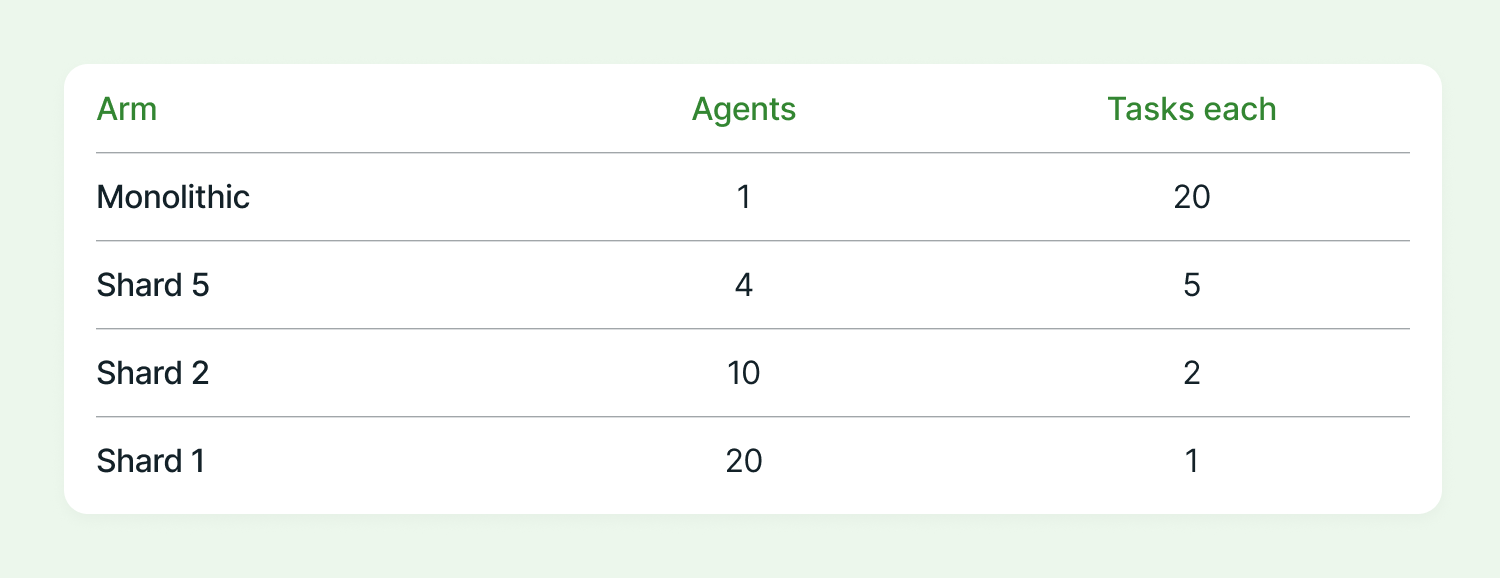
Every arm ran on Claude Haiku 4.5, with the same permission model and a prompt template identical across arms down to the wording, since prompt length is itself a token cost. Arms ran sequentially rather than together, because launching them concurrently would have made them compete for the same scheduler and turned wall-clock into a measurement of the queue instead of fan-out.
The cost curve
Serial time is the sum of each agent's own wall-clock, the time the run would have taken if every agent executed one after another instead of concurrently. It is the true measure of total compute, independent of how much concurrency was available.
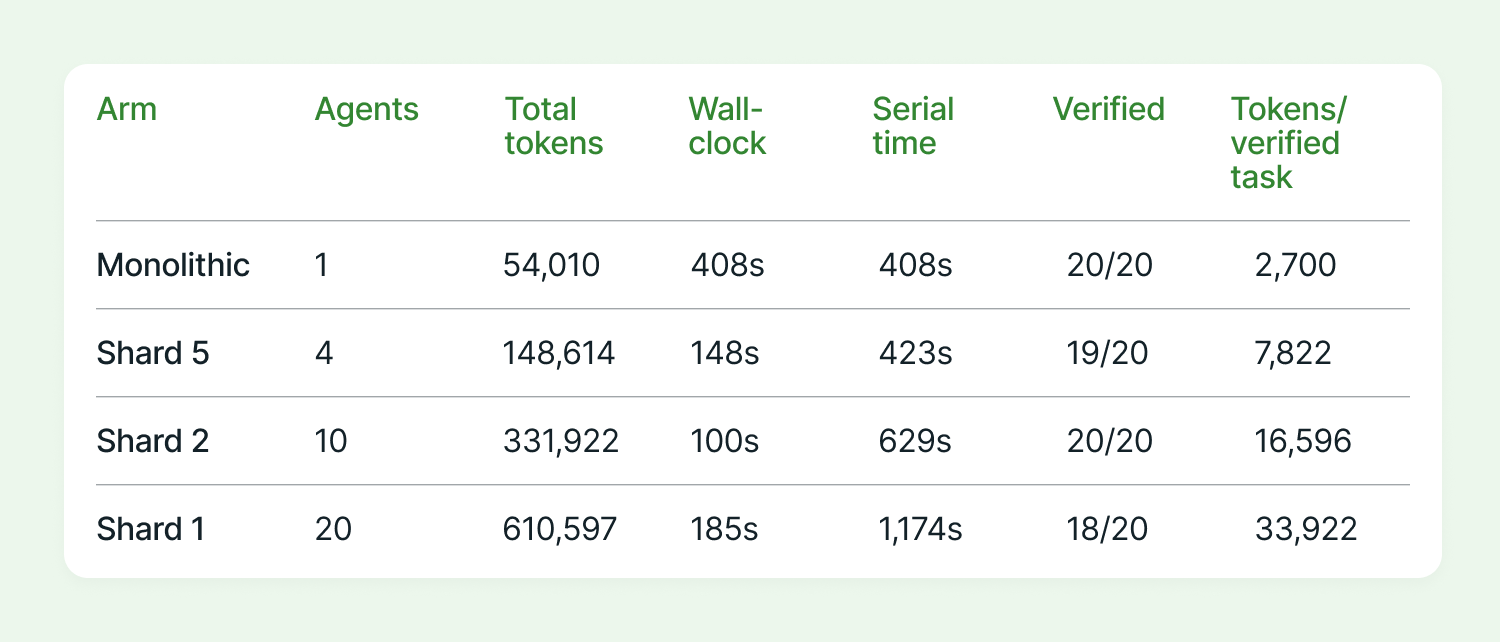
The same unit of work costs 2,700 tokens inside a busy agent and 33,922 tokens when it gets an agent of its own. That is a 12.6x difference in price for an identical outcome, and it is invisible in any per-task view of your system.
The per-agent fixed cost was strikingly stable. Across the ten agents in the shard-2 arm, the spread was 4.5% of the minimum. This is not noise; it is a constant you can plan against.
Look at the serial column too, because it undercuts the intuition people usually bring to this. Total compute time goes up as you fan out, from 408 seconds to 1,174. Wall-clock time falls only because the work happens concurrently. You are not doing less work. You are doing considerably more work, in less time, and paying for every bit of it.
Fan-out is fairly priced once, and then it is not
The useful way to read the table is as an exchange rate, meaning tokens spent per second of wall-clock time bought.
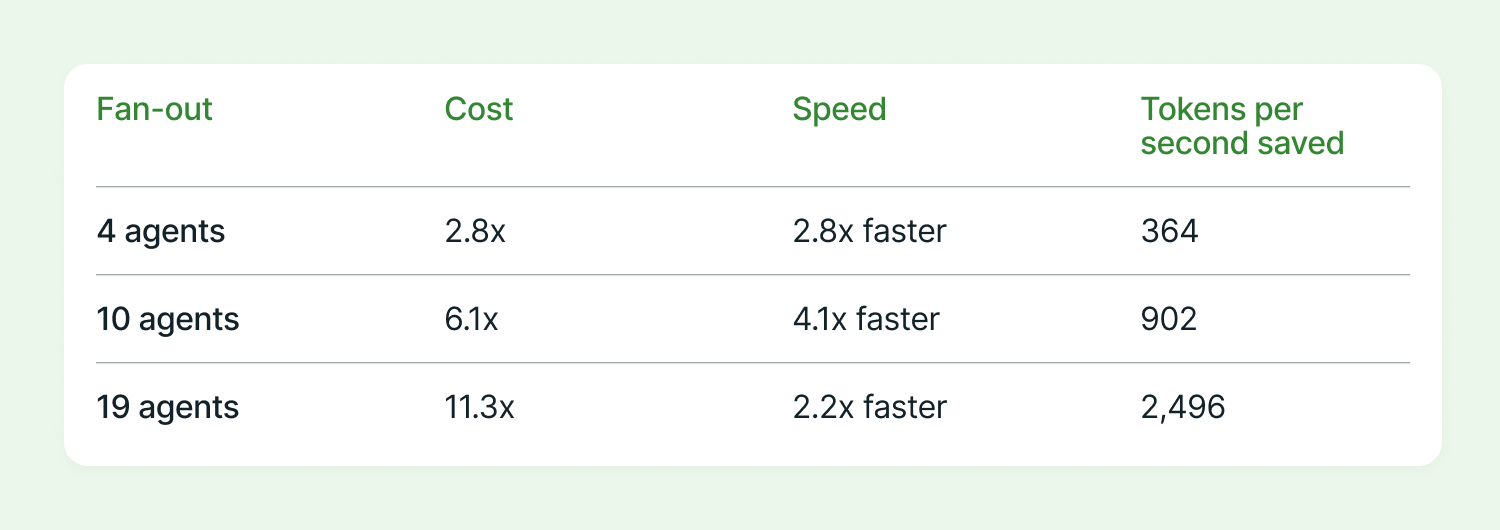
The first split is close to fair value: You pay 2.8 times the tokens, and you get 2.8 times the speed, which is a trade a lot of teams would take without hesitating.
The second is worse but arguable: Six times the cost for four times the speed still makes sense if latency is what your users feel.
The third is a clear loss: Going from ten agents to nineteen cost an extra 278,675 tokens and finished 85 seconds later than the ten-agent run did. More money, worse latency, on the same tasks.
That reversal happens because parallelism has a ceiling that spend does not. Past some concurrency limit, whether that limit is your orchestrator, your rate limits, or your own infrastructure, additional agents queue instead of running. The queue costs you nothing in tokens while they wait, but every one of them still pays its 31,000-token entry fee the moment it starts. You buy no speed and pay the full price.
I want to be careful here, because my own run makes this look slightly worse than a clean measurement would. My nineteen-agent wall-clock was inflated by launching in two batches and by the harness concurrency cap. But that caveat is the finding restated rather than an excuse. Nobody has unlimited concurrency; the ceiling is always somewhere, and your token bill keeps climbing after you hit it.
The failure mode that scales with agent count
One agent in the twenty-agent arm stalled completely, and a watchdog killed it after ten minutes. Its API calls had landed and its task verified, but the agent never returned to report its cost. That is a process failure, not a task failure: the work got done, the worker didn't.
Separately, two tasks in that same arm came back wrong: one agent messaged the wrong billing contact, a genuine quality failure, and a harness classifier unrelated to fan-out blocked the other mid-task. That is a 10% verified-failure rate in the twenty-agent arm. The four-agent arm also lost a task, for 5%; the ten-agent arm and the single-agent arm each came in at 0%. It is a small sample, and I am not going to claim a rate from it, but the pattern doesn't neatly support "more agents means worse quality" since the failures showed up at four agents and twenty, not at ten.
What does scale cleanly with agent count is the process risk. Every agent you add is another thing that can hang, and in a fan-out topology a stalled worker blocks the synthesis step behind it. Your reliability is the product of your workers' reliability, so a topology with twenty workers has twenty chances to need a timeout policy, a retry policy, and a partial-result policy that a single-agent design never needs at all.
Those policies are engineering you now own. They belong in the total cost of ownership next to the tokens.
What this means for build vs. buy
Teams usually frame the decision as whether orchestration is complex enough to buy rather than build. My numbers do not contradict that, but they do change what you should be comparing.
Vendor orchestration is not free just because the framework is. Any topology that spawns agents pays the 31,000-token entry fee per agent, whether you wrote the spawner or bought it. When you evaluate a platform, the question is not whether it orchestrates well. It is how aggressively it fans out by default, and whether you can control the shard size. A product that spawns a specialist per subtask is making a pricing decision on your behalf.
Time to value and cost of ownership point in opposite directions here. Fan-out is the fastest way to get a demo feeling responsive, and it is the most expensive way to run that demo at volume. The configuration that looks best in a pilot is the one that hurts most in production, which is exactly the trap that makes pilots misleading.
Shard size is what flips my answer. Below roughly 27 tasks per agent, spawning costs more than the work. Above it, the fixed cost amortizes, and fan-out starts making sense on tokens as well as latency. If your workload naturally arrives in large batches per worker, buy the orchestration and fan out. If your workload is a stream of small independent requests, a single long-lived agent handling many of them is dramatically cheaper, and the orchestration layer is a solution to a problem you do not have.
What's worth buying isn't the fan-out. It's the timeout, retry, and partial-result machinery that fan-out forces on you, plus the telemetry to see any of this. I could write this article only because every agent reported its tokens, duration, and tool-call count. If your platform does not surface per-agent cost, you cannot compute your own version of this table, and you will not find out what your topology costs until the invoice arrives.
Check this against your own system
Take your orchestration layer and compute one number: the average count of discrete tasks each spawned agent completes before it exits. Not the number of tool calls but the number of units of work you would have billed a human for.
If that number is below roughly 27, your fan-out is spending more on starting agents than on the work they do, and consolidating shards will cut your token bill without touching your success rate. On my workload, the monolithic arm and the ten-agent arm both verified 20 out of 20, and one of them cost six times more than the other.
That 27 is the falsifiable part, and it is specific to my task size and my harness. Fit your own line: run the same workload at two shard sizes, record tokens per agent, and solve for the intercept. It takes two runs. If your intercept comes out near zero, your orchestration is cheaper than mine, and I'd like to see how, because the number I keep getting is remarkably stable and nobody seems to publish it.

Recent articles






Insights for leaders building AI systems
Weekly digest of the most important ideas in AI transformation.