



















The AI fluency gap: why clarity is the first step in building an AI-ready workforce


We know that all companies want an AI-fluent workforce. But, before employees can become truly fluent in AI, companies need to be clear about what that means. Poor or abstract definitions will not lead to positive outcomes. In fact, companies that do have a clear definition of AI fluency are considerably more effective at tailoring AI learning solutions to their workforce, which is an essential part of effective delivery.
According to Andela's new research, those with a clear definition of AI fluency are:

At Andela, we define AI fluency as the demonstrated ability to deliver verified, production-grade work with AI: deciding what to delegate to models and agents, directing them precisely, verifying what they produce, knowing where human judgment is required, and owning the result. It is measured by the impact of what ships, not how much AI is used, and should be assessed against the skills a role actually requires, not generically across a business.
The definition of AI fluency doesn't need to be the same across organizations, but it does need to be clear in order to be effective. But our study found that only 42% of businesses currently have a clear definition of AI fluency that extends throughout the organization to include specific expectations across different job functions. And, unsurprisingly, given this lack of clarity, companies are failing to power their AI ambitions with appropriate learning pathways, meaning the issue becomes even murkier.
In this report, supported by a study of 300 business leaders from the UK and US, we examine the AI fluency gap and the impact it has on training effectiveness. And crucially, we explore ways of closing it.
Two tiers of AI fluency are emerging
The study shows that 60% of companies have a clear, organization-wide definition of AI fluency. This is encouraging. But only 42% say that they have gone beyond the base definition to set out specific expectations for different roles and functions. The reality, then, is that less than half of businesses are operating with clear and specific expectations of what AI fluency means to every member of the workforce.
The remaining 40% of companies have failed to reach any kind of clarity on AI fluency. A fifth (20%) offer guidance about what AI fluency is (or should be), 17% simply encourage employees to improve their AI capabilities, and, shockingly, 3% have not even communicated any expectations about what AI fluency means at all.

The data may not add up to 100% due to rounding.
Across regions, these trends are consistent, with 57% in the U.S. and 63% in the U.K. believing they have a clear definition, neither is far from the average. But at the sector level there is more variance: 67% of healthcare and life sciences companies have a clear definition of AI fluency, while only 52% and 57% in technology and telecoms, respectively, can say the same. (A mitigating factor may be that in these last two sectors AI is more deeply embedded, meaning that AI fluency is assumed to be present rather than explicitly recognized and measured.)
The two-tier nature of AI fluency maturity is concerning but perhaps unsurprising, given that measurement of AI fluency is also inconsistent.
Businesses are unclear about how to measure AI fluency
Accurately assessing where employees are on their AI fluency journeys helps businesses to highlight persistent issues or training gaps and design a suitable program to remedy the situation. Unlike traditional company-wide training (e.g., SOC 2), AI requires more tailored training to drive adoption, and it cannot be treated as a one-size-fits-all technology.
Our data shows that businesses are conducting these assessments, but no consistent method has yet emerged as a standard for all to follow. More than half (56%) of companies trust the completion of AI training and certification as a measure of AI fluency. This can give a good overview in terms of the percentage of the workforce that holds such a certification, but it is arguably too generic a measure to reflect the true AI fluency of an organization. We also found in a separate study that while most individuals understand conceptually what AI can do, they fail in the everyday mechanics of how to put it into practice.¹
A more accurate way of assessing AI fluency could be through either actual work or simulated work-related tasks. Yet at present, only 52% of businesses do this. Employers also use adoption rates and self-assessment among employees.

On a regional basis, favored methods to assess AI fluency vary. In the U.K., the most popular method is to measure adoption and AI tool usage (57%), while in the U.S., businesses prefer employees to complete training and gain certifications (59%). Across job roles, an interesting pattern emerges. The chief technology officer (CTO), head of AI, and technology innovation director prefer to use training and certifications to assess AI fluency, but chief information officers (CIOs) prefer to assess it based on real work assignments.
Employees are worried about AI assessments
Methods of measuring AI fluency vary, but their impact on employees consistently evokes concern about how their performance in any assessment will reflect on them.
Almost half (46%) worry about who would have access to the results of any AI fluency assessment and how they would use those results, and a similar portion (43%) are concerned about how their results would reflect on their roles. Around a third worry that AI fluency tests could reveal gaps in their knowledge (37%), affect their career progression (36%), or simply reveal that they are using the technology incorrectly (31%).

These concerns, like most around AI more broadly, are legitimate. Companies must ensure complete transparency around how AI fluency results are distributed and used in order to ensure both vigorous participation and acceptance of their validity across the workforce.
Carrol Chang, CEO of Andela, understands these fears and says companies must work hard to allay them.
Effective AI assessment systems are designed to support employees' growth When employees experience measurement without support and coaching, organizations create fear.
Companies that can take assessment results and use them to power tailored learning solutions that help employees do their jobs better will be most successful.
AI training: more method, less madness
Companies recognize the importance of training, but only 43% say their employees currently receive AI training tailored to their specific role. What's more, only around half (52%) say employees are given the chance to practice their AI skills in their own work.
Another important theme revealed in the research is the way that employers assess skills gaps among their workers. For most (54%), AI skills gaps are assessed after training takes place, in order to gauge how effective that training has been. Only 44% assess skills gaps in AI before training takes place to ensure it can be tailored. In order to create true AI fluency, more businesses must take the latter approach and assess AI fluency first. Once gaps are identified, they can be properly addressed in training. Only then does post-training assessment become truly valuable, as it measures how well those specific gaps have been filled.

At the sector level, professional services and technology firms are getting this right, with companies conducting pre- and post-training assessments at a similar rate (in professional services, 48% do pre- and post-training assessments, and in technology, 53% do pre-training assessments, and 52% do it post-training). Meanwhile, in healthcare and life sciences, only 30% of businesses are assessing skills gaps before training takes place, and 56% do it afterwards, representing the biggest gap in pre- and post-training assessments of all sectors.
Organizations need support in assessing AI fluency
Companies are struggling to develop a coherent program of AI fluency assessments. Our research reveals the top barriers companies face to gaining an accurate picture of their employees' AI fluency:
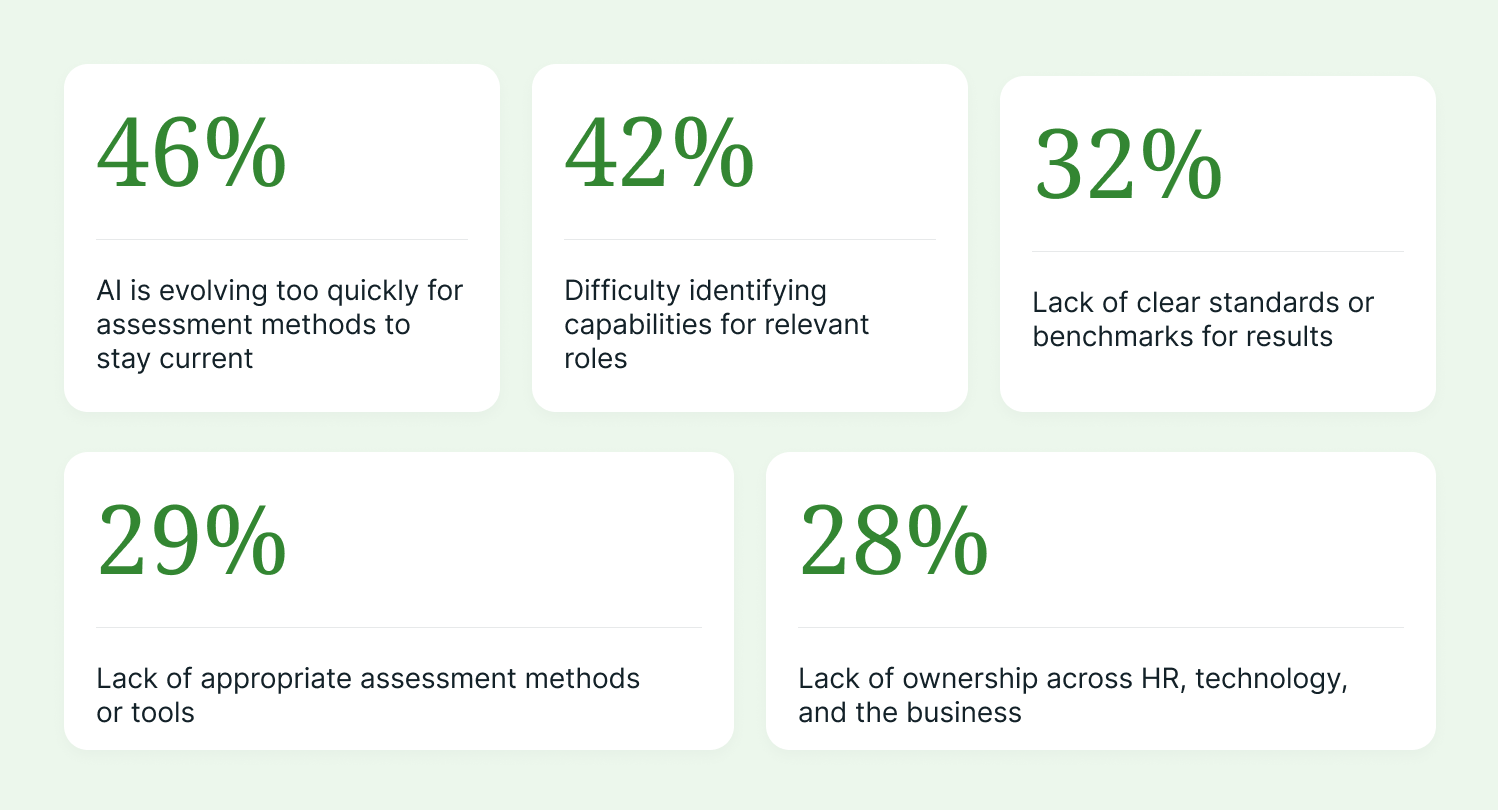
Despite widespread concern about the breakneck speed at which capabilities are developing, the evolution of the AI landscape is unlikely to slow anytime soon. CTOs, CIOs, and technology innovation directors all cite this rapid progression and doubts about their organizations' ability to keep pace as their top concern, a sentiment that is consistent across most industries.
Interestingly, the second-highest barrier to getting an accurate picture of AI fluency (particularly among heads of AI) is around identifying capabilities for relevant roles. Given that only 44% assess the AI skills gap before training takes place (thereby limiting their ability to tailor that training to requirements), more careful, deliberate assessment of gaps in AI fluency seems an obvious remedy to this anxiety.
Greater clarity on AI fluency drives effective AI training
Many companies still have some way to go when it comes to embedding AI fluency across their organizations. Training is haphazard, and assessment methods panic employees. However, the data suggests that having a clear definition of AI fluency is essential: The 60% with higher clarity on AI fluency outperform the remaining 40% when it comes to effectively tailoring AI learning solutions to their workforce.
For instance, those with a clear definition of AI fluency are 90% more likely to assess skills gaps before training takes place, in order to tailor it more appropriately, than those without a clear definition of AI fluency (55% versus 29%). They also lead in every other area, including tailoring AI development to individual capability gaps, giving opportunities to practice AI through relevant work, and receiving role-specific AI training.

Being able to tailor AI learning pathways to workforce needs is an essential step toward building AI fluency. And the data suggests that those with the clearest definitions will be best placed to achieve it.
Clarity is the key to closing the AI fluency gap
AI fluency is essential to the future of organizations. Getting there doesn't start with training or assessments, important though these are.
Rather, it starts with clarity. Our research shows that the companies with the clearest definition of AI fluency are more effective at tailoring AI learning solutions to their workforce and, by doing so, empowering their people.
Essential first steps for companies aiming to bring greater clarity around AI fluency:

With greater clarity, businesses can begin to close the AI fluency gap and start realizing better business outcomes with AI.
About the research
Andela commissioned FT Longitude to conduct, in August and September 2026, a survey of 300 respondents: 150 from the U.K. and 150 from the U.S. Half of the respondents were C-level executives, with the rest representing the director level or C-1 level (reporting directly to the C-suite). CTO, CIO, head of AI, and technology innovation director roles were represented equally. Companies came from the following sectors: financial services, technology, energy, professional services, healthcare and life sciences, and telecoms, and had an annual revenue of at least US$100 million.
Andela enables enterprise organizations to adopt and deliver AI at scale. The AI-native services company offers skill assessment, learning programs, and solution delivery through fully managed teams and embedded technical talent. Andelans around the world are driven by the founding mission to connect brilliance with opportunity. Learn more at andela.com
Recent articles





Insights for leaders building AI systems
Weekly digest of the most important ideas in AI transformation.