Scaling Engineer Skill Levels From Simple AI Access to Fluency


What a 3-week Codex Enablement Program Reveals About Building Agent-Native Engineering Capability
Most engineering organizations embrace AI adoption, but actual fluency levels remain uneven. A small group of developers may be using AI tools fluently, while others are experimenting inconsistently, overloading prompts, misusing context, or struggling to apply AI inside governed delivery workflows.
Andela’s 3-week Codex Learning Program — comprising two weeks of structured learning followed by a one-week hackathon build — tested whether structured enablement could close that gap. The applied developer training course was designed to help engineers move from casual Codex usage into disciplined, agent-native engineering practice. The results show measurable gains in applied AI engineering knowledge. The program also led to faster decision fluency among participants and the strongest lift among developers who started with the largest knowledge gaps.
Impact at a Glance
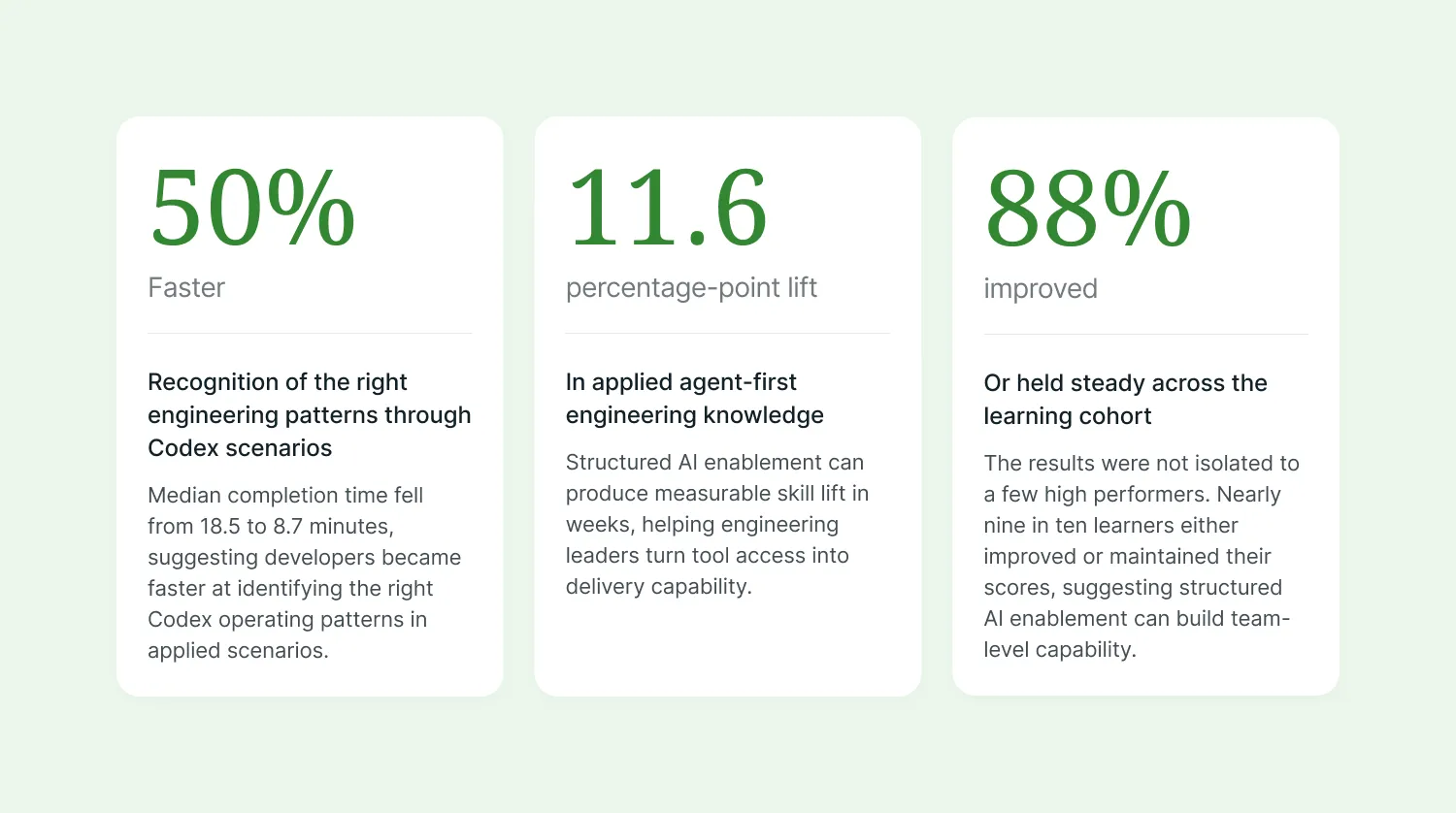
The results show that structured, applied AI enablement can translate quickly into measurable engineering capability. Across technical roles, learners recognized the right patterns faster, strengthened their agent-first knowledge, and demonstrated gains that extended beyond a small group of top performers.
The Bigger Takeaway: AI Fluency Scales When Teams Raise the Floor.
The clearest improvements came from developers who started the 3-week program with the lowest baseline scores, gaining 3.45 additional correct answers on average. That matters because enterprise AI adoption can’t scale through advanced users alone. It requires the broader engineering organization to align on the confidence, judgment, and shared practices needed to use AI responsibly in real delivery workflows.
What the Results Suggest for Engineering Leaders
The study measured applied, scenario-based decision-making; crystallizing the practical layer developers need before AI-assisted engineering can become repeatable, governed, and safe enough for day-to-day engineering work.
The strongest gains appeared in the operating skills that help teams move faster while keeping AI-assisted delivery trustworthy. Among them:
- Sandbox and network constraints: understanding how Codex operates safely inside controlled environments.
- Verification design: defining “done” through clear checks before accepting AI-generated work.
- Context hygiene: keeping instructions durable, relevant, and maintainable.
- Parallel agent work: using worktrees to support parallel agent workflows.
- Team defaults: knowing when to use MCPs, skills, automations, SDK workflows, and repo-level standards.
For engineering leaders, this reframes speed: faster AI-assisted development only returns enterprise value when teams have shared standards for context, verification, governance, and workflow integration. Without those standards, speed can create risk. With them in place, AI-assisted development becomes easier to adopt, trust, and scale.
Why Engineering Teams Need an AI-Augmented Operating Model Now
AI-assisted development is already becoming part of day-to-day engineering work. For organizations that have invested in tools like Codex but are not yet seeing consistent value, waiting does not preserve the status quo. It allows individual habits to harden before the organization has defined safe, repeatable ways of working.
The research shows why this matters. Developers may understand the vision of agent-first engineering, but still struggle to choose the right Codex mechanism in real workflows. That limits license ROI and creates three practical risks for organizations:
- Uneven adoption: advanced users move ahead while the broader team remains inconsistent or lagging in confidence.
- Unreliable workflows: teams may rely on oversized prompts, external context, or generic automation patterns where durable standards are needed.
- Unsafe speed: AI-assisted work can move faster than the organization’s verification, review, and CI/CD guardrails can support.
That is where structured enablement becomes operationally important. It helps teams define how they manage context, verify AI-generated work, choose the right mechanisms, and embed AI safely into delivery workflows. Two examples from the research show what that looks like in practice:
Keep durable standards close to the code.
For always-applicable engineering guidance, teams need reliable, maintainable context that lives with the repository. The research surfaced this as a common mechanism-selection gap: developers often favored dynamic external context, while the intended pattern was durable markdown standards referenced from AGENTS.md.
Use structured integration when AI enters CI/CD.
When Codex is part of CI/CD review, findings, comments, or merge-gating, the research points to the Codex SDK as the stronger pattern than skill-, MCP-, or script-based workarounds. This helps AI-assisted workflows fit inside formal engineering controls.
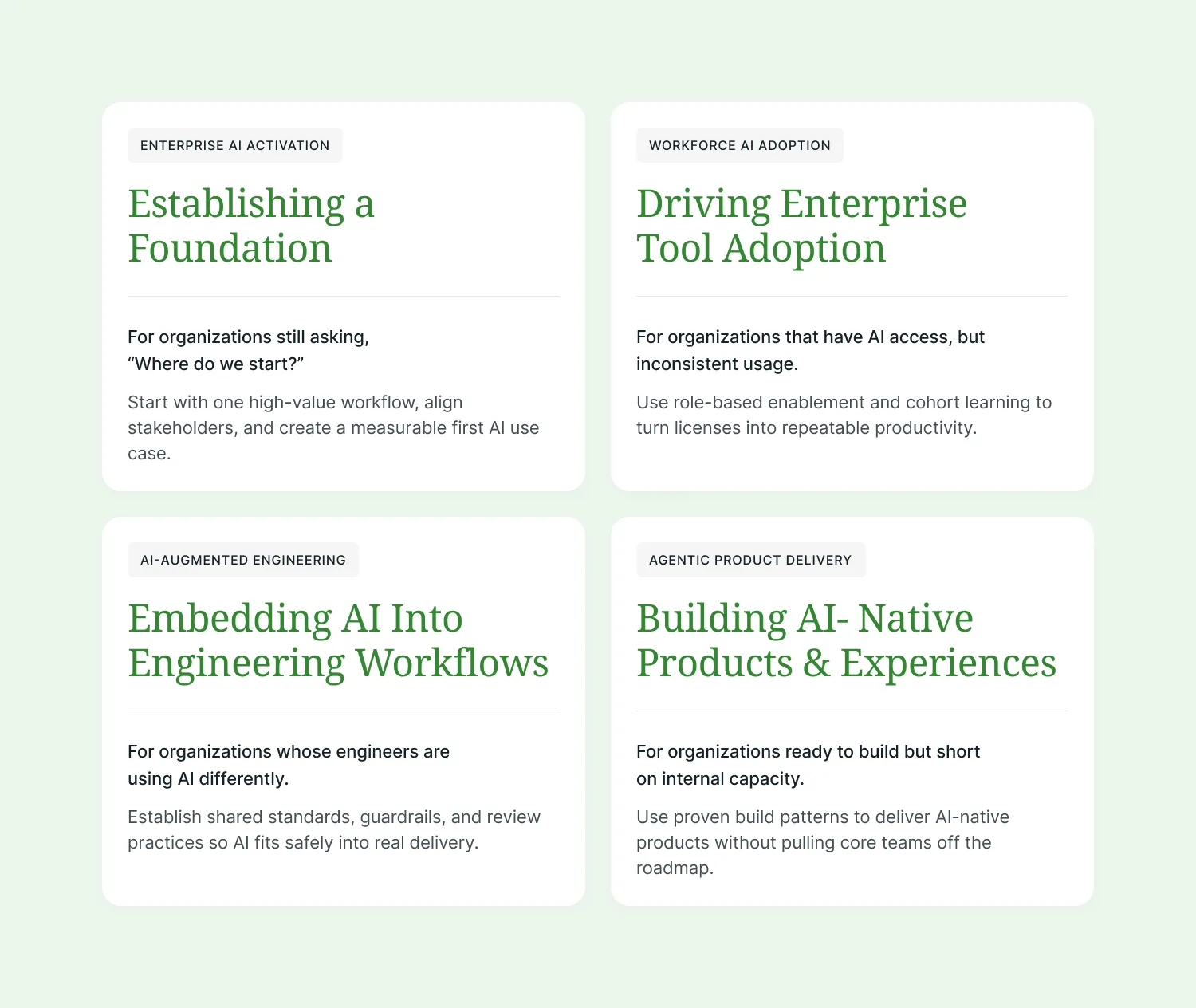
How Organizations Can Move From AI Access to AI Fluency
Unlocking a practical maturity path for organizations that want to move from AI experimentation to measurable engineering capability.
About Andela. Andela helps organizations align workforce strategy with AI strategy, combining AI talent, managed delivery, and workforce enablement to help enterprises build, deploy, and scale AI with confidence.
Recent articles

.webp)

.webp)
.webp)
.webp)
Insights for leaders building AI systems
Weekly digest of the most important ideas in AI transformation.