



















A job by any other name


The work is changing faster than we can figure out what to call it.
Tim Sackett has seen plenty of hard-to-fill jobs. But these were for car dealership service centers, selling tires to customers who'd come in for routine maintenance.
The trouble? The company called the role "advisor." Nothing in the title said sales or tires. The postings attracted almost no applicants. Once Sackett reworked the titles to describe the role more accurately, the client's hundred open spots filled in 90 days.
Sackett's client picked the wrong title from day one. The bigger problem in tech is a title that was right once, until the work itself changed and nobody noticed.
That's what Andela's researchers found in Fortune 500 software hiring.
Of the 1,832 Fortune 500 postings with titles like AI Engineer and ML Engineer, 53% already asked for skills from a newer bundle that crosses established roles, one with no settled name yet.
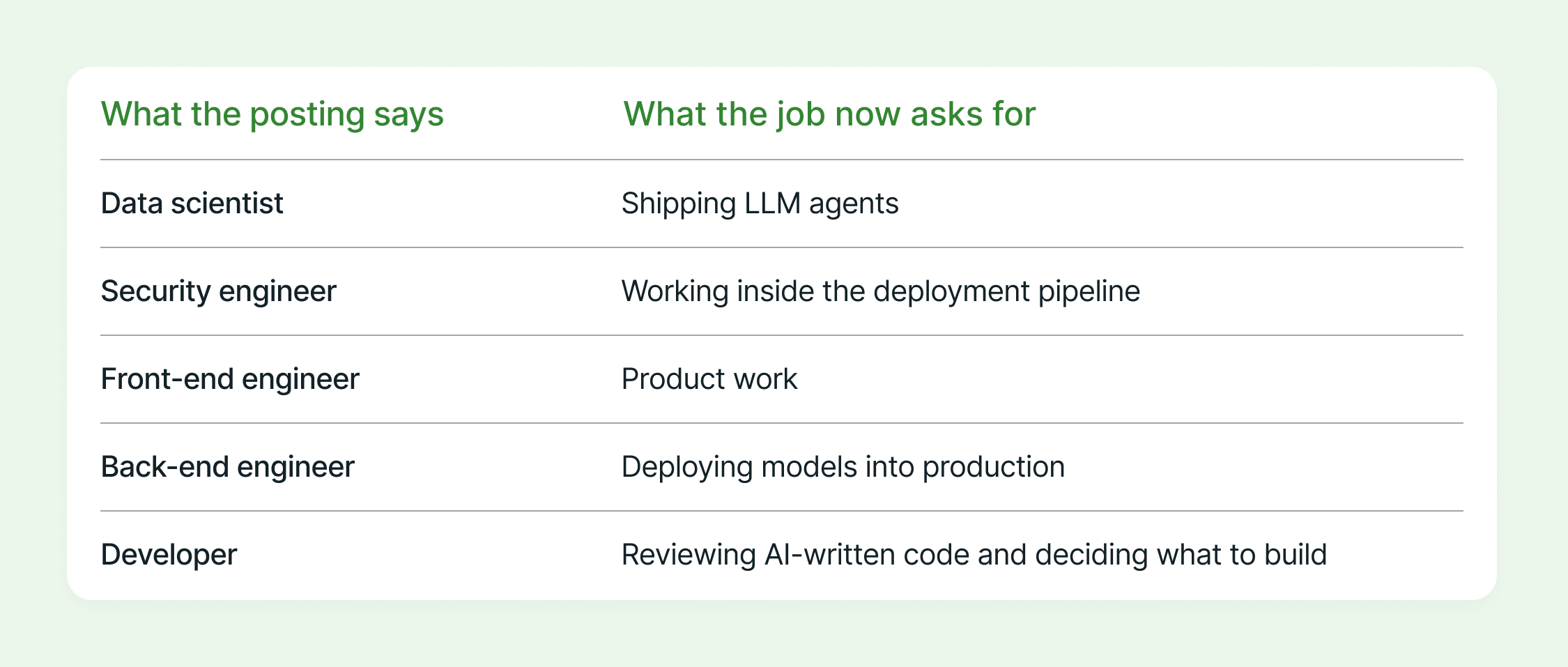
"Job titles lag the work," writes Cory Hymel, Andela's head of research, who led the study. "A company hires a 'data scientist' and then asks them to ship LLM agents; it posts for a 'security engineer' who turns out to live inside the deployment pipeline. The skills move first, and the title catches up years later."
The talent version of playing telephone
By the time a new role reaches a job board, the work has usually been lost in translation. In an interview with Stack Overflow, Hymel called that trip a chain of custody: the person closest to the work describes what's needed, then it goes "to HR, and then to finance, and then procurement, and then eventually a recruiter." The work gets more ambiguous at every step, he said, "not only in the description, but the understanding of what the role should be."
The last step in that chain is often a copy-and-paste job. Kat Kibben has spent their career on that step. They're the founder of Three Ears Media, a consulting and training firm that works with both sides of that handoff, teaching hiring managers and recruiters how to write job posts that attract the right candidates. The firm also audits and rewrites postings for employers ranging from Fortune 100 companies to small businesses.
"In most cases, a job description never matches the work people actually do because the first step most people take to write a job posting is to copy and paste something old," Kibben said. "I can't think of another document where the old version is so consistently used without any review."
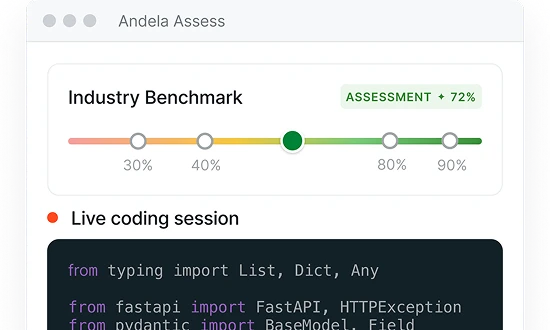
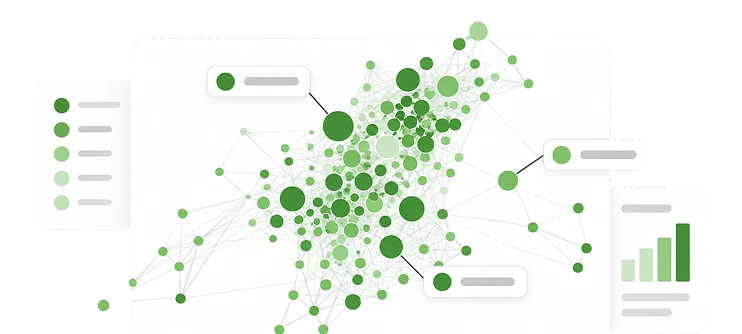
Andela's data shows the result. The team analyzed 47,101 Fortune 500 software job postings collected over five weeks this spring and looked for what Hymel calls skill bleed. Every skill has a home role it historically belongs to. When skills from different homes keep turning up together, a new role may be forming in the seam between two older ones. The study found 23 of those bundles. Andela judged eight of them genuinely emerging. One bundle, which Andela calls LLM Application Engineer, turned up in 6,758 postings, whatever their titles said.

Kibben's fix is to start from the work, not the old posting. Begin with why you're hiring, then what the person will do each day, then the requirements. The title comes last.
Remember when "computer" was a job title?
New jobs have always started as bundles of old ones. ML Engineer formed in the gap between software engineering and statistics, and DevSecOps formed between development, security and operations. Hybrid jobs are well documented. The labor market analytics firm Lightcast has been studying them for years. Andela's bet is that they're forming faster now, and Hymel's study is built to catch them early. Instead of tracking posting volumes over time, it spots new bundles in a single snapshot.
Henry Hays sees both sides of the shift. He's an AI strategy consultant at Sparkhound, a Gulf Coast IT consulting firm that helps companies with AI and data strategy, custom software and managed IT services. He's also an adjunct instructor at Louisiana State University, where he co-teaches a course on building applications with large language models. "'Computer' used to be a job title," he said. Rooms full of people, mostly women, did calculations by hand for NASA and the Army. "Then the machine took the name and the job disappeared. Titles follow work. They never lead it."
He sees it happening to developers now. Five years ago, a developer spent most of the day writing code. Today, the same developer might spend the day reviewing code an AI wrote, deciding what to build and catching the mistakes the machine was confident about. "Same title. Same desk. Different job," he said.
The data also cuts against a popular prediction. Plenty of people expect AI to turn every engineer into a generalist. "We didn't see in the data this idea of a net generalist," Hymel told Stack Overflow. The bleed shows up in the seams between neighboring roles: front-end engineers stretching into product work, back-end engineers learning to deploy models into production.
Andela ties the findings to a wider idea it calls talent debt: the skills a role needs are going stale faster than they used to. Hays has watched that cycle speed up. Prompt engineer went from an unknown title to a six-figure posting to a skill everybody is expected to have "in about the time it takes to renovate a kitchen."
Not every bundle becomes a job, though. "Skills cluster all the time without becoming jobs," said Mykyta Chernenko, a software engineer and author of The Rational Software Engineer. Prompt engineer is his example. "For a while it looked like a title, but the outcome it owned belonged to whoever owned the feature, so it folded back into ordinary engineering." Andela's own audit points the same way: most of the 23 bundles it found are hybrids that settled years ago, not new jobs. Some new work hasn't settled at all. AI Agent Developer, the role plenty of people expect to come next, hasn't formed into a stable bundle in Andela's data. Five weeks of postings can't measure how fast skills go stale, the report notes, but they can show which bundles are fusing into new roles.
So how do you know when a bundle has become a job? Hays has a three-part test. The work shows up every week, not every quarter. The business notices when it doesn't get done. And it's distinct enough that you can't add it to someone's existing job "without that job breaking." New tools alone don't count. "A carpenter with a nail gun is still a carpenter," he said. A role needs a new name "when you'd hire a different person for it today than you would have five years ago."
The new job hiding in plain sight
Every organization has a person doing a job that doesn't exist yet, Hays said. "Nobody gave them the job. They just started doing it. They're the one everyone walks over to when the AI output looks wrong." That person is the earliest signal a company has. A new role shows up on your own teams long before it shows up on a job board.
Waiting for the job board to catch up means waiting years. Andela dated the technologies in each bundle it found, and in postings collected in 2026, none had a median birth year later than 2019. "As skill half-lives shorten, the roles forming in the gaps between today's jobs are where tomorrow's talent debt accrues," Hymel writes, "so seeing them early is the point and why I did this."
Hays has seen what happens when a company relies on postings anyway. An engineering manager needs someone who can manage AI coding agents and review their output at speed. HR pulls the job description from 2021, and recruiting runs keyword searches against it. The candidates would have been perfect four years ago. "Everybody did their job right," Hays said. "And the hire still misses." In his view, "Title drift isn't an HR problem or a tech problem. It's a translation problem."
Start by finding that person. Hays asks whether their work is spreading to other teams, what breaks when they're on vacation, and whether the company would hire for it from outside. "If you'd post it, it's real," he said. "Don't invent new roles. Discover them."
Once a role is visible, companies can expand the skills of the people they have or hire from outside. Nicole Roberts would look inside first. She's director and principal analyst at 3Sixty Insights, a research and advisory firm that studies how companies choose and use business software, including HR technology, and she leads its research on workforce strategy. She spent more than 20 years in HR leadership before that. Begin with strategy, she said, then the handful of roles most critical to it, and define what good looks like in that work today. "Find out what capabilities you already have before you go buy more, whether that means talent or technology."
That inside-first approach is also how Andela works with engineering teams. Its agentic engineering programs start with the engineers a company already has and move them from occasional AI use to running AI coding agents and reviewing what those agents ship.
When a team does need to hire, the prep matters. Lindsey Guyette is senior manager of talent acquisition for Americas R&D and G&A at Twilio, the communications software company. "I always tell my talent advisors that our job is 95% prework and 5% showing up," she said. When an engineering leader asks for a new mix of skills, she wants to know what titles, levels and scope of work competitors are targeting, and "which of those titles are driving applicant activity." Doing that work up front costs less than fixing it later. "Trying to experiment with your search strategy once the role is already live is expensive," she said.
Sackett, who has spent more than 25 years in HR and talent acquisition and wrote The Talent Fix, a recruiting guide published by SHRM, has seen employers learn how much a title shapes who applies. "I think programmatic advertising has educated job ad buyers to understand 'unique' job titles are problematic for applicant flow," he said. The harder case now is a title that's simply new, like Agentic Workflow Engineer, where "just because of the newness people might not understand what it is."
A better title fixed the problem for Sackett's dealership client. For many of the roles in Andela's data, there isn't a better title yet. Somewhere on your team, someone is already doing one of those jobs. Ask them what they'd call it.
Recent articles






Insights for leaders building AI systems
Weekly digest of the most important ideas in AI transformation.